Most early-stage founders think they have an ICP definition. Push on it and you find a market segment. "Small business owners." "Marketing teams." "Developers who care about performance." These are not Ideal Customer Profiles. They are descriptions of a third of the economy, which is functionally the same as describing no one.
A fuzzy ICP feels harmless in the early days. It is not. It quietly corrupts everything downstream: your content speaks to the average of everyone and compels no one, your sales calls wander because you have not pre-qualified who you are talking to, your feature roadmap accepts every request as equally valid because you have no profile to weigh it against. This guide shows you how to define your ICP from real evidence — the same four-question framing from our content strategy guide for solo founders, gone considerably deeper.
Why does a vague ICP cost you more than you think?
The CB Insights analysis of startup post-mortems is the most cited statistic in this category, but the MEST Africa analysis of 431 startup shutdowns since 2023 is more recent and more instructive: 43% cited poor product-market fit as the top root cause of failure — and poor product-market fit is almost never the result of a bad product. It is almost always the result of a product aimed imprecisely at the wrong version of the right person.
That gap between "people who might want this" and "the person who definitely wants exactly this" is where most early-stage growth capital disappears. You chase leads who were never a fit. You discount to close people who churn anyway. You build features to satisfy customers you never should have acquired. A McKinsey survey of over 500 executives found that only 15% consistently incorporate customer input into business decisions, even though 63% cite customer feedback as a top growth lever. The gap between saying you know your customer and actually knowing them is larger than most founders realise until they look at the data.
If your ICP describes everyone, it guides no one. Specificity is not a niche strategy — it is how you make every hour count.
The cost shows up first in content. When you do not know precisely who you are writing for, you write to the average — and the average reader does not exist. Ahrefs' study of over one billion pages found that 90.63% receive zero organic traffic, overwhelmingly because they target queries no specific person actually searches. That is what fuzzy ICP targeting looks like at scale: publishable, indexed, invisible.
How do you define your ICP from real evidence?
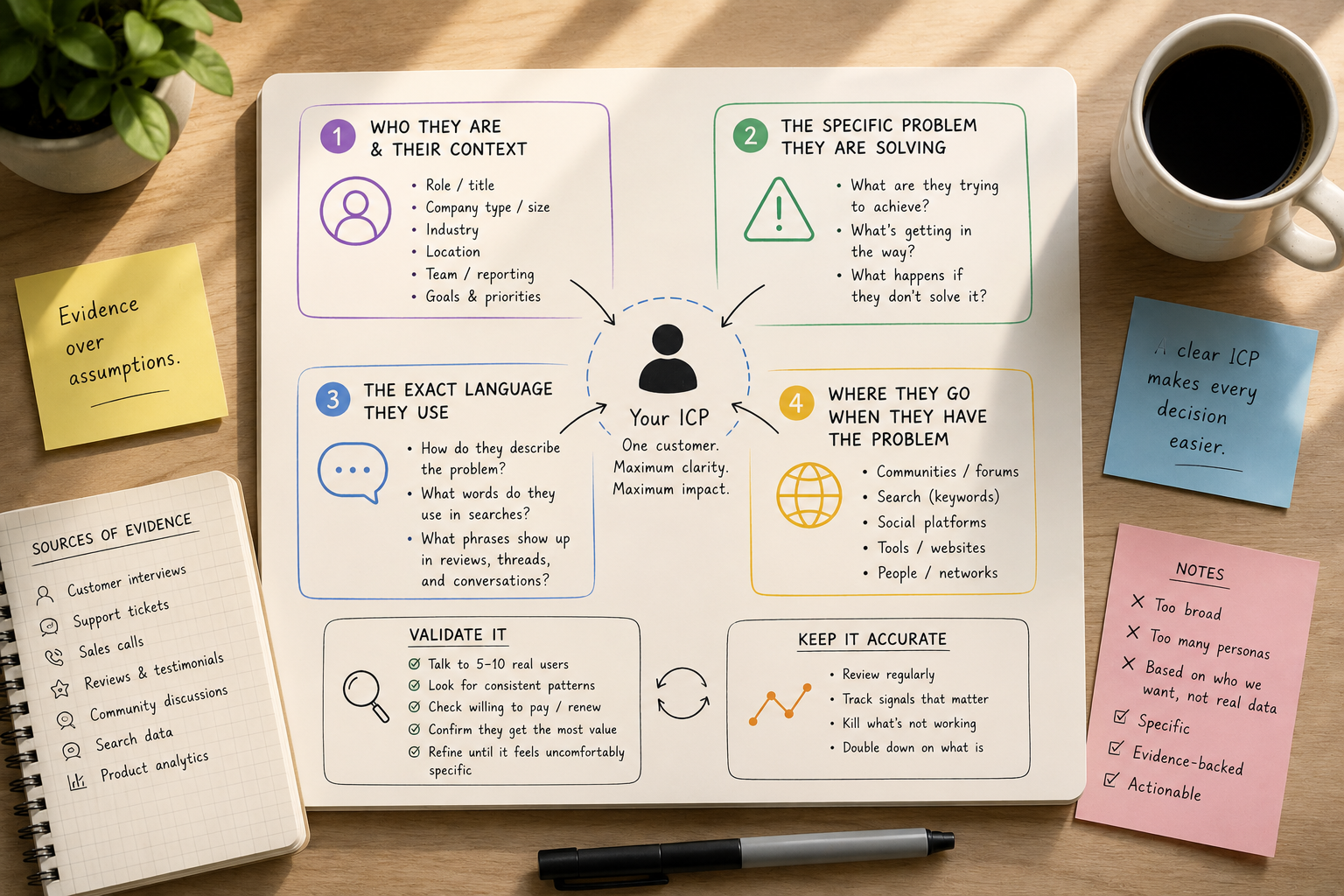
The four-question framework is the spine of a usable definition. The difference between a guess and an ICP is where your answers come from — real language and observed behaviour, not the story you tell yourself at a whiteboard.
Question one: What is their role and context?
Go past the job title. "Marketing manager" is a segment. "The only marketer at a twenty-person B2B SaaS company who owns the blog, the newsletter, and the demand number, with no budget for an agency" is an ICP. Role, company size, team size, budget authority, and what they are measured on — these context signals are what make your positioning land because the person reading recognises themselves immediately rather than vaguely.
Question two: What is the specific problem they are actively trying to solve?
Not "growth." Not "efficiency." The problem they are spending real time or money on right now. "How to produce consistent content without hiring" is a real problem. "Marketing" is a department. The test: would this person pay money, or spend meaningful time, specifically to solve this problem today? If you are unsure, the answer is no, and you need to go one level more specific.
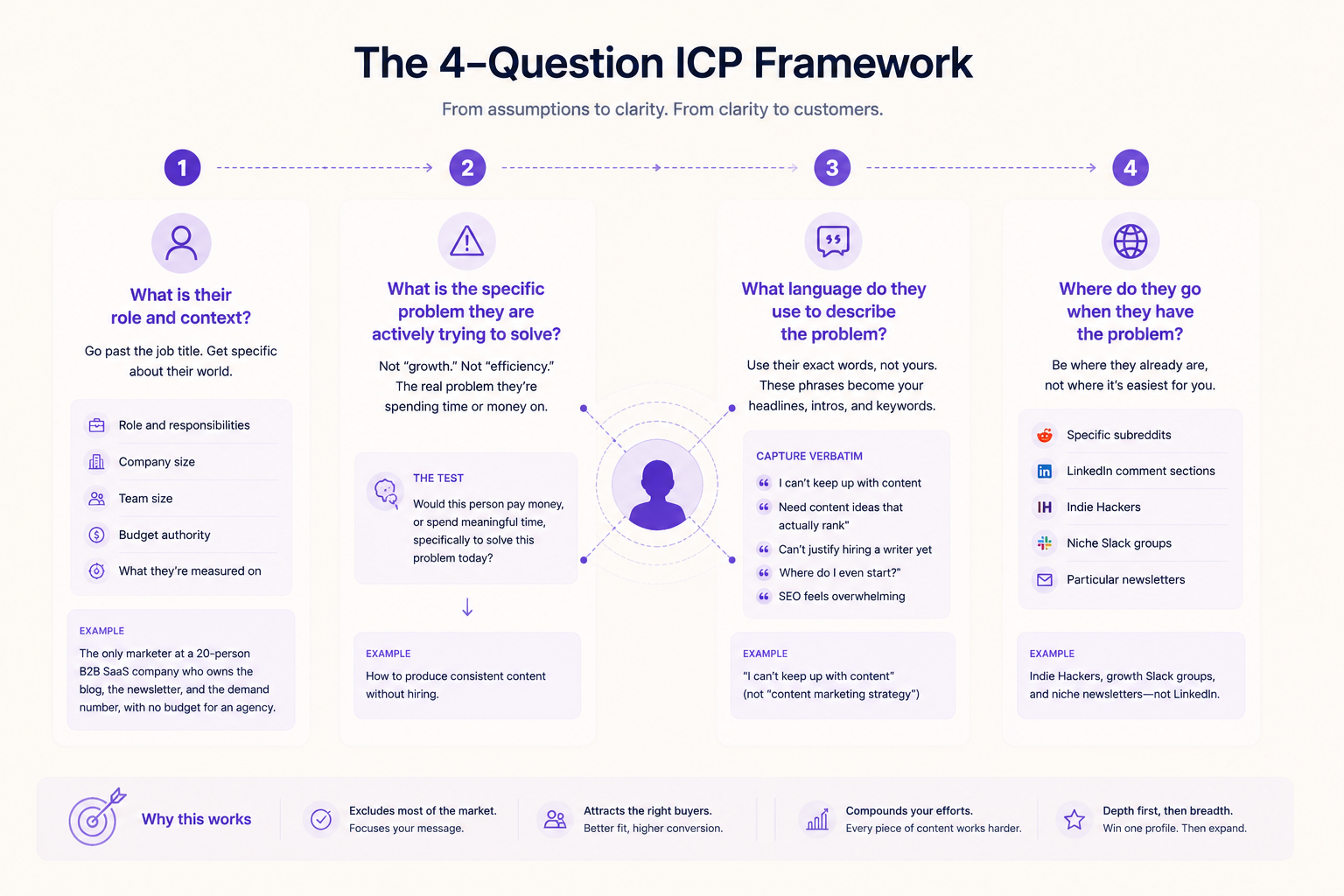
Question three: What language do they use to describe the problem?
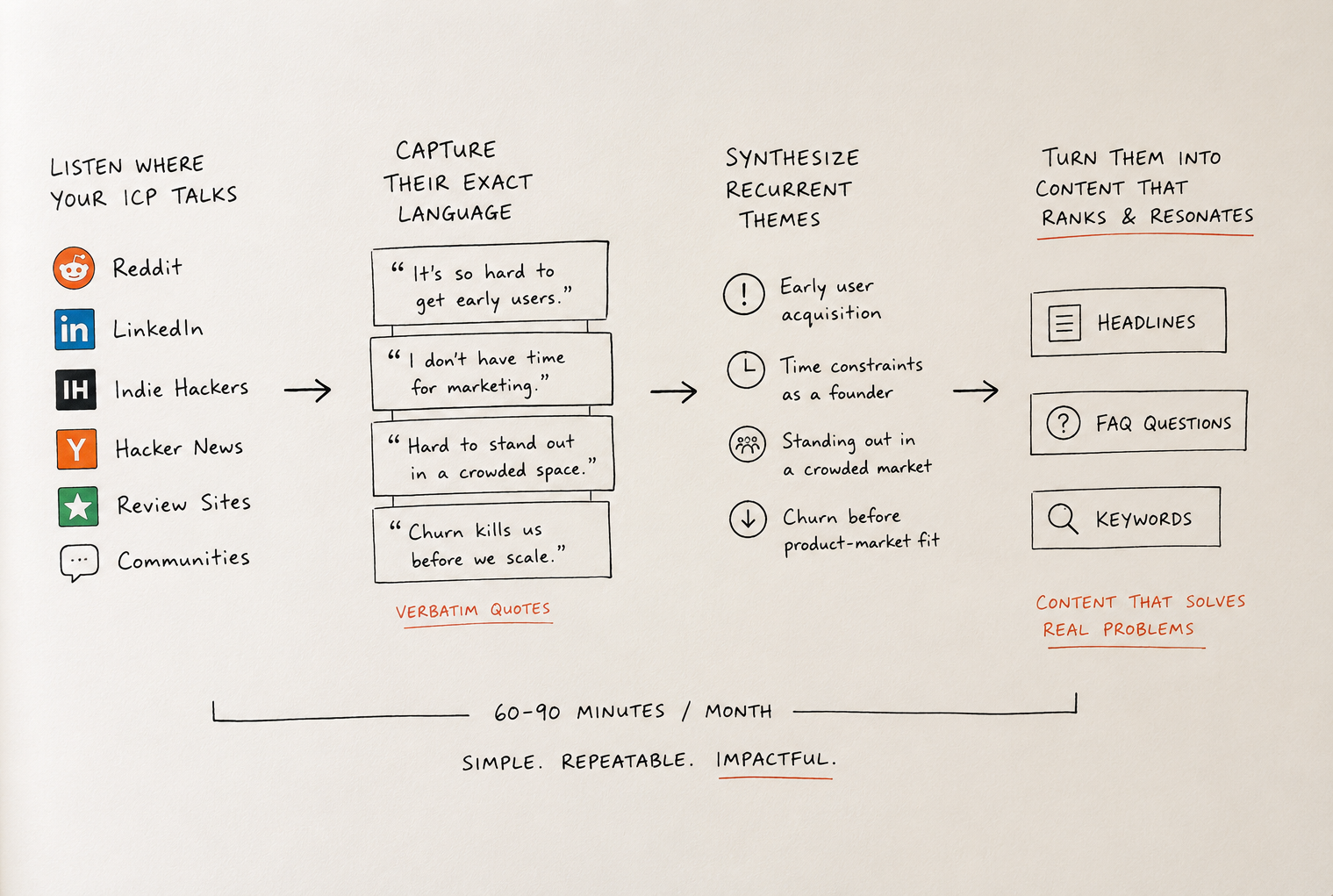
This is the question founders most often skip, and the one that pays best. The words your buyer types into Google and posts in communities are blunter, more specific, and more emotionally honest than your positioning copy. "I can't keep up with content" is different from "content marketing strategy." Capture them verbatim. Those phrases become your headlines, your intro paragraphs, and — most directly — your keyword research for early-stage founders. The exact wording your ICP uses is what they will search for.
Question four: Where do they go when they have the problem?
Specific subreddits. LinkedIn comment sections. Indie Hackers. Niche Slack groups. Particular newsletters. The channel that matters is where your ICP already congregates, not the one easiest for you to use. If your ICP does not spend time on LinkedIn and you invest in LinkedIn content, you are producing for yourself.
Where does the evidence come from before you have customers?
Three sources you can access today, before a single paying customer.
Community mining. Go to the places your target buyer already complains about the problem. Read with the goal of capturing their exact phrasing — not their general sentiment, their specific words. Our social listening guide for founders covers exactly how to do this without losing a week to it.
Direct conversations. Five to ten short calls with people who fit your hypothesis. Not customer validation sessions. Just conversations where you ask what they are struggling with and then stop talking. The only rule is to listen more than you speak, and to write down the exact words they use, not your interpretation of them.
Competitor analysis. Study who your closest competitors clearly serve and who they clearly ignore. Their highest-rated reviews reveal who gets the most value from similar products. Their lowest-rated reviews reveal who does not — which is often where your opening is.
How specific should your ICP be?
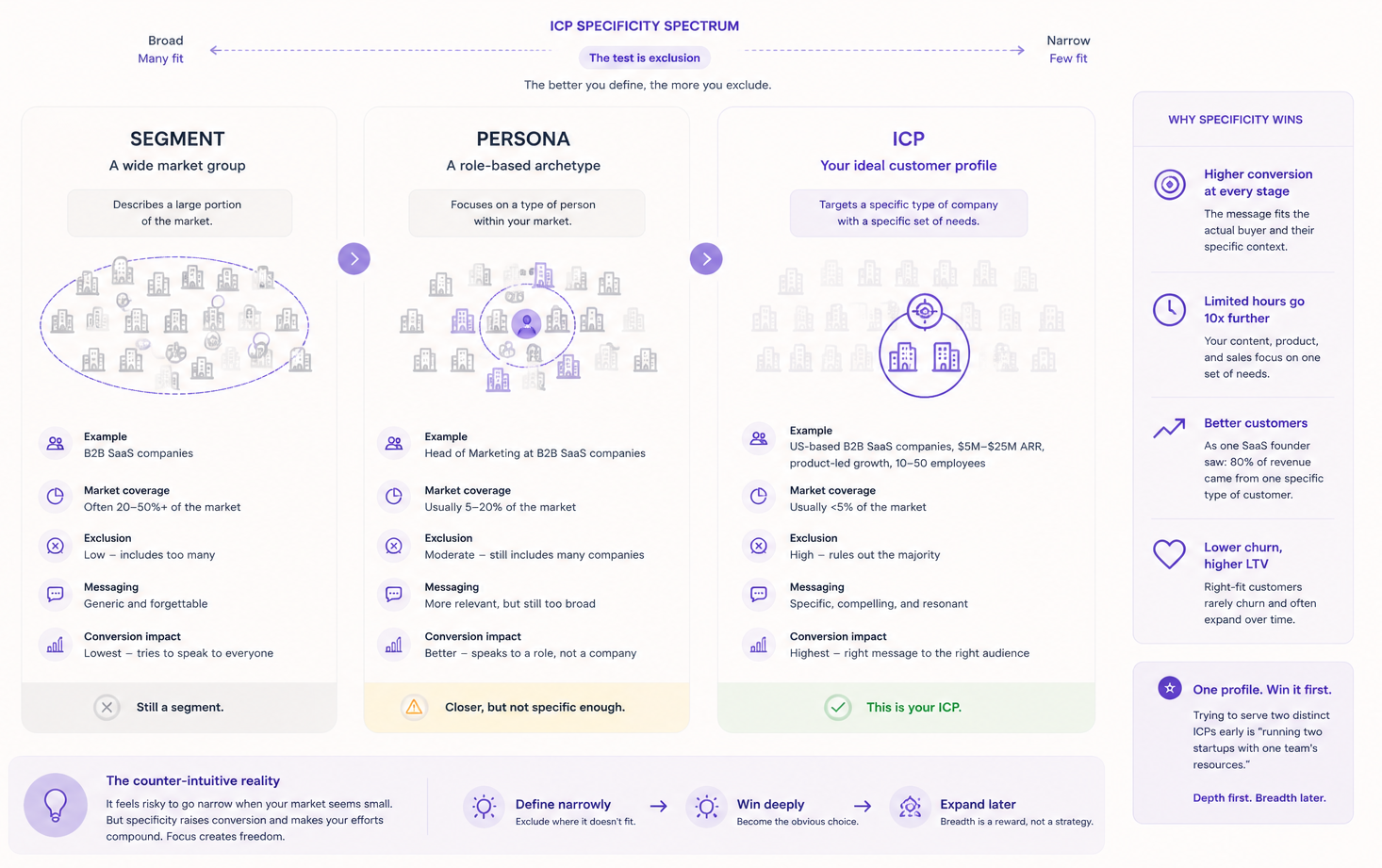
The test is exclusion. A good ICP excludes most of the market. If your definition describes a third of the companies you can think of, it is still a segment. If it describes fewer than five percent, you are in the right territory.
This feels dangerous when your addressable market already seems small. The counter-intuitive reality: specificity raises conversion at every stage because the message fits, and it makes your limited hours go much further because you are not trying to serve incompatible needs simultaneously. As one SaaS founder coaching case study put it: 80% of revenue came from one specific type of customer, and those customers rarely churned and often upgraded within six months — once they narrowed their focus to that profile, everything accelerated.
Trying to serve two distinct ICPs early is what one investor called "running two startups with one team's resources." Each ICP demands different feature priorities, different messaging, different content, and different sales motion. The product you need for each is often fundamentally different, not just different in emphasis. Win one profile first. Breadth is a reward you earn after depth.
How do you validate and keep your ICP alive?
A definition written and filed is a guess that aged well. The ICP that actually helps you is one tested against reality and revised when reality disagrees — which it will, often, and usefully.
Validate it the moment you can. Watch whether people who match your profile convert at higher rates than those who do not. Watch whether content written in their captured language outperforms your more generic posts. Watch your churn: the customers who stay quietly tell you more about your true ICP than the ones who signed up. If your best customers keep looking different from the profile you wrote, update the profile.
Build lightweight feedback loops so signal reaches you without effort. Tag the reason every deal is won or lost. Skim support tickets monthly for recurring language. Keep a running note of phrases buyers actually use unprompted. This is the same capture habit that feeds a content calendar you can sustain — the ICP and the content engine run on the same raw material.
A reasonable cadence: a light review each quarter, and a deeper rethink whenever a pattern surprises you. Your ICP is not a brand positioning document to be finalised once. It is a live hypothesis about who you are building for, updated every time the evidence gets sharper.
Where Sia fits
Sia keeps your ICP definition tied to live evidence — surfacing the language your target customer is using in communities right now, the questions they are asking, and the keywords that match their actual search behaviour. It turns a static one-page document into a profile that updates as you learn, so your content and positioning stay aimed at the right person rather than the person you assumed they were six months ago.
Start this week. Write the one-page version: role and context, the specific problem, the exact words they use, and where they spend time. Pressure-test it against five real conversations. Then keep it alive — because the founders who define their ICP precisely, and keep revising it against evidence, build content and sales motion that actually compounds. For the wider system this sits inside, return to our content strategy guide for solo founders.