
In 2024, HubSpot — a company that had spent years building one of the most-cited content marketing playbooks on the internet — lost roughly half of its organic traffic in a matter of months. Not to a technical issue. Not to a competitor outranking them on every keyword. Partly because years of publishing broadly, on topics only loosely connected to their core product, had quietly eroded the topical signal their site sent to Google. Their response was instructive: they started cutting and consolidating content aggressively rather than publishing more.
A content audit is how you get ahead of that problem before it compounds. This guide walks through the complete process — how to inventory every published page, score it against the three signals that matter, and make a clear keep/update/merge/ redirect/delete decision without a consultant or a tool subscription.
What is a content audit — and why does content debt compound?
A content audit is a systematic pass over everything your site has published, where each URL gets scored and assigned a single decision. That is the whole exercise. The inventory is easy. The judgement is what makes it valuable.
The reason founders run them is content debt. Every thin, outdated, or off-topic page you have ever published is still telling Google something about what your site knows. A cluster of weak pages dilutes the signal that you are an authority on anything in particular. Think of it as topical authority being a bucket: strong, relevant pages fill it; weak, scattered pages drain it.
The scale of this problem is easy to underestimate. Ahrefs' study of over one billion pages found that 90.63% receive zero organic search traffic from Google. On most early-stage sites, the majority of published content is doing nothing — and worse than nothing, because it still consumes crawl budget and fragments your authority across topics you have no real claim on. The audit is how you find those pages before Google decides your domain is not particularly expert in anything.
The counterintuitive payoff: refreshing existing content consistently outperforms publishing new pieces. Research tracking updated posts found that republishing with fresh data, improved structure, and stronger targeting can produce over 100% increases in organic traffic from the updated pages. Your best future traffic may already be written — just buried under a weak title and stale data.
You do not build topical authority only by publishing more. You build it by removing what should not be there.
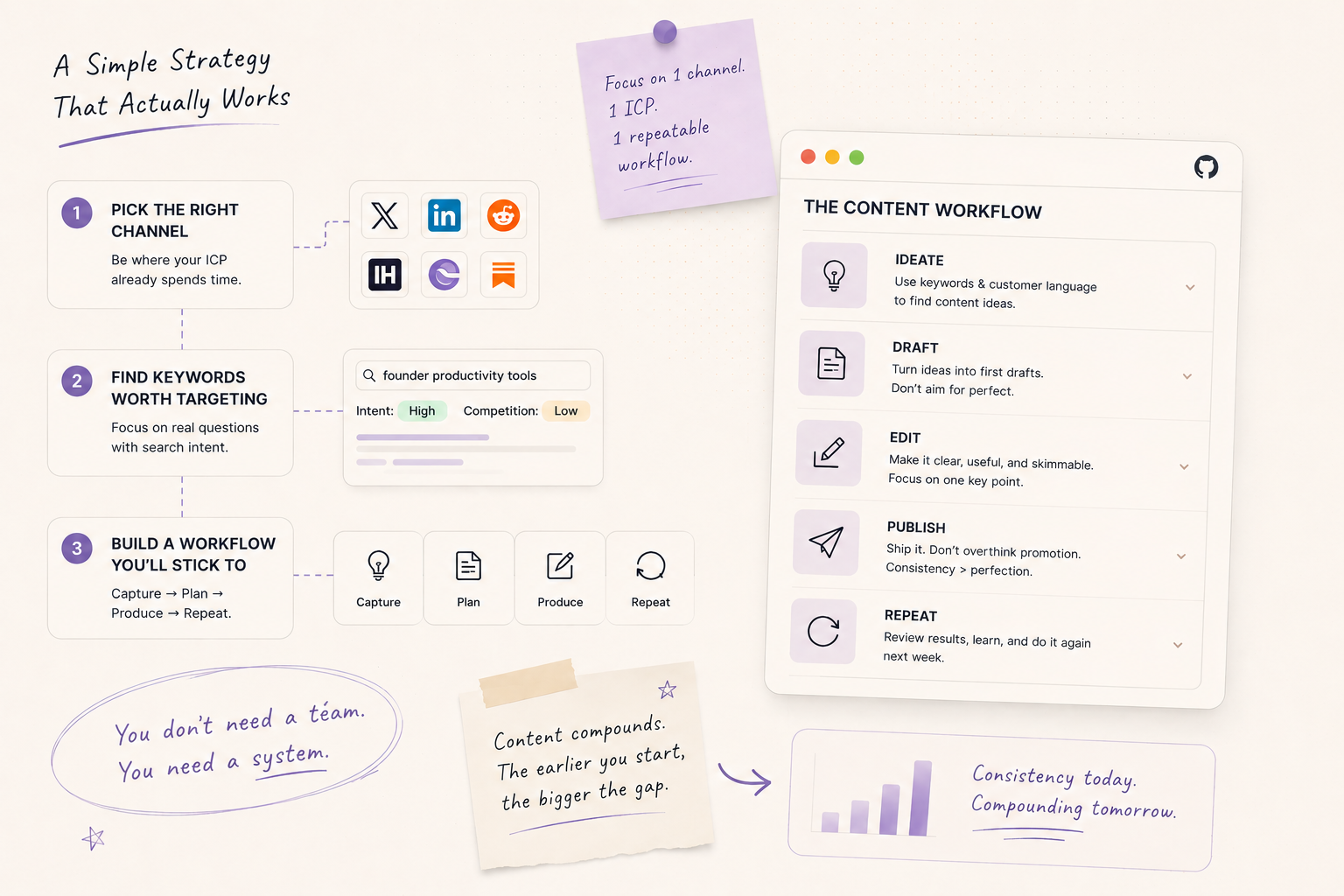
If you have not yet built the content system that an audit cleans up, start with our content strategy guide for solo founders — the audit is downstream of having a channel, an ICP, and a keyword map in place.
When should you run a content audit?
The honest trigger is volume and staleness, not the calendar. A site with eight posts does not need an audit; it needs to publish more. Once you can no longer hold your entire content footprint in your head — somewhere past twenty to thirty published pages — you are accumulating debt faster than you realise.
Three specific moments make an audit the right move:
Before a major topic push. If you are about to invest in building out a keyword cluster, audit what already exists in that cluster first. New content built on top of weak, competing pages will underperform from day one.
After a traffic drop. A sudden decline almost always traces to a handful of pages that have gone stale, started competing with each other for the same keyword, or were caught by a helpful content update. The audit surfaces which ones.
On a regular cadence. A light pass every six months for monthly publishers. Every quarter once you cross fifty pages. The faster you publish, the faster debt accrues, and the more a regular rhythm pays back.
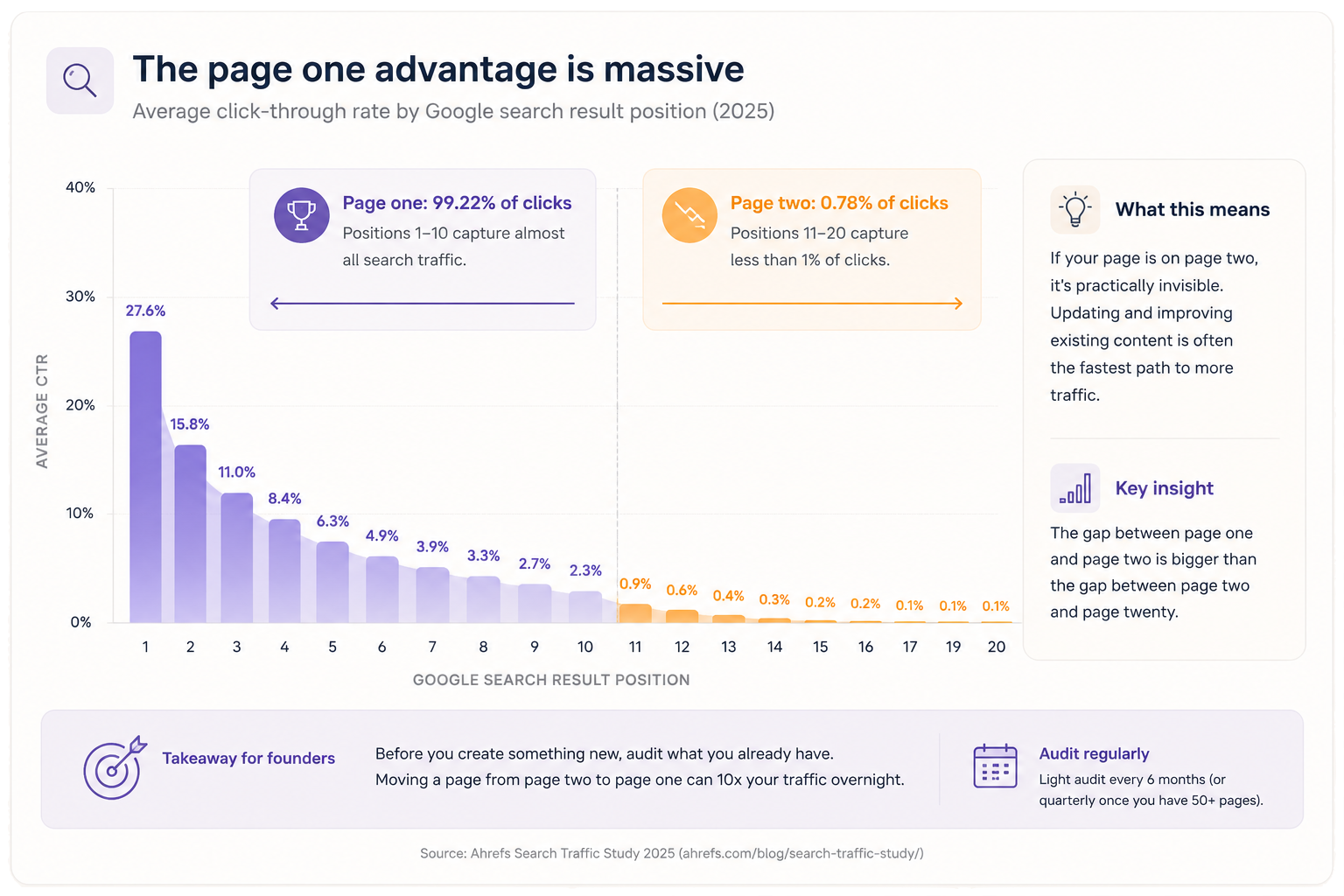
The data on page two is worth holding in mind here. Ahrefs' 2025 CTR analysis found that page two of Google search results captures just 0.78% of clicks — essentially nothing. A page stranded on page two is not performing at its actual value. The fastest way to push it to page one is often an update, not a new post.
How do you build a content inventory?
The inventory is fast and boring, which is exactly how it should be. Get every published URL into one spreadsheet alongside the numbers you will judge it on. Resist any impulse to elaborate the structure — a founder audit fails when the setup takes longer than the analysis.
One row per URL. These columns, nothing else:
- URL — pull your full list from your sitemap, your CMS export, or Screaming Frog if you have it.
- Search impressions (last 90 days) — from Google Search Console, free. Filter to organic search.
- Organic sessions (last 90 days) — from Google Analytics 4.
- Conversions — trial starts, newsletter signups, or whatever next step the page is meant to drive.
- Target keyword — the query the page was built to rank for.
- Last updated — the publish or last-edit date.
- Decision — blank for now; you fill this in after scoring.
That is enough. Anything beyond seven columns adds overhead without improving the decision you make about each page. The discipline here is the same one that makes a lean content calendar stick — the simpler the system, the more reliably you run it.
How do you score each page?
With the inventory built, three signals decide every page's fate. Read them together — no single number tells the full story.
Search impressions is the leading indicator. It tells you whether the page is appearing in search at all. A page with healthy impressions but few clicks has a title and snippet problem, not a relevance problem — the keyword is being searched, Google is surfacing the page, but nothing is compelling the click. A page with near-zero impressions after six months either targets a keyword nobody searches or is not properly indexed.
Organic sessions is the lagging indicator. This is the actual traffic the page earns. Fewer than roughly twenty organic sessions a month after ninety days is underperforming — but read it with impressions, because the two together explain why. High impressions with low sessions means fix the snippet. No impressions at all means the page may need to go.
Conversions is the signal most founders completely ignore. Traffic without a defined next action is brand awareness at best. A page can carry modest traffic and still be a strong keeper if it converts well. A page that drives thousands of sessions and converts nobody is a CTA problem — fixable, but worth flagging.
Keep, update, merge, redirect, or delete: the decision rule
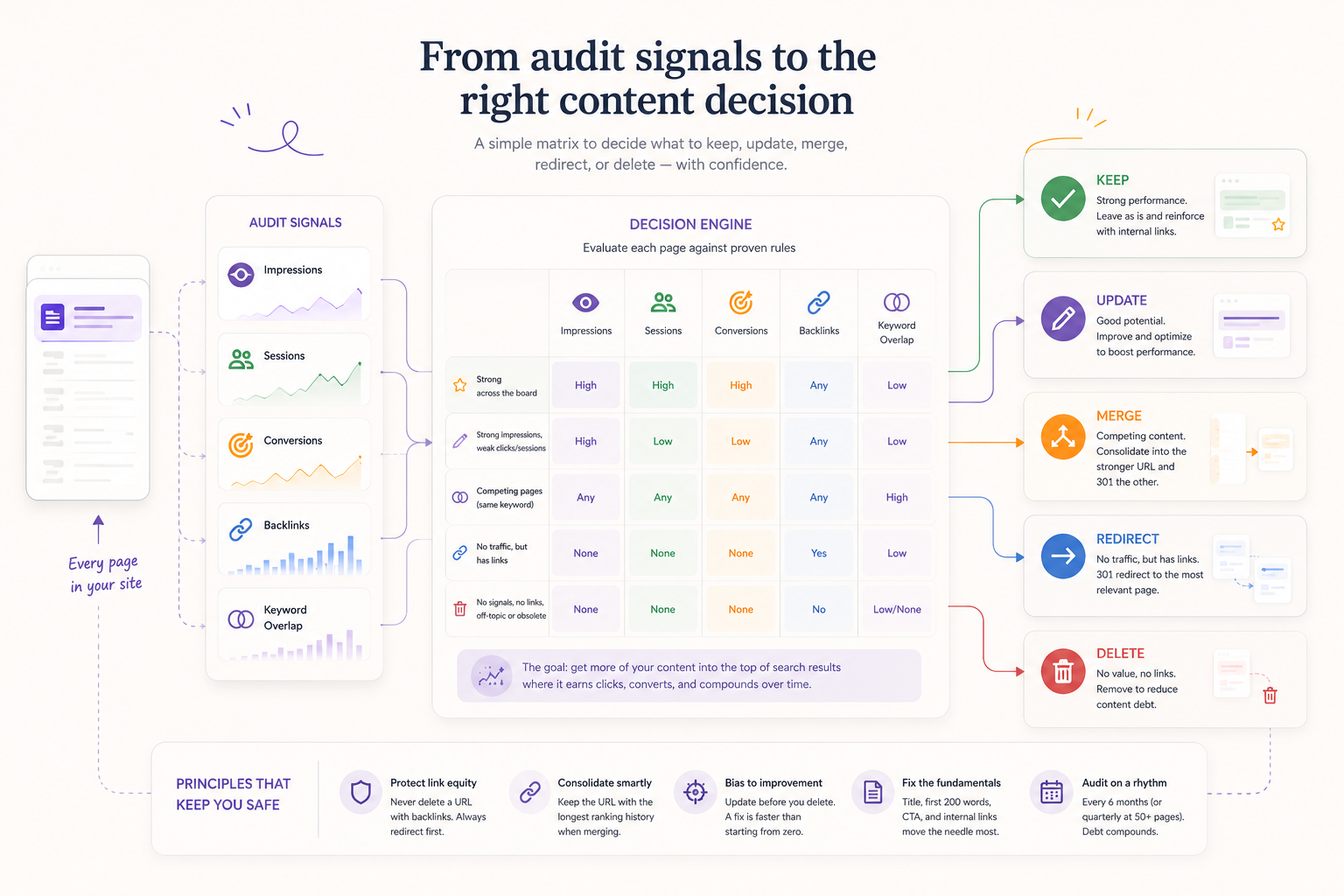
This is the part of the audit that requires actual judgement. Everything else is data collection. Here is the framework:
| Signal pattern | Decision |
|---|---|
| Strong impressions, sessions, and conversions | Keep — leave it alone, reinforce it with internal links |
| Strong impressions, weak clicks or sessions | Update — rewrite the title and first 200 words, refresh data, tighten the CTA |
| Two pages competing for the same keyword | Merge — consolidate into the stronger URL, 301 the other |
| No traffic, but the URL has backlinks or internal links pointing at it | Redirect — 301 to the most relevant surviving page |
| No impressions, no links, off-topic or obsolete | Delete — it is only adding content debt |
A few principles make this safe to apply quickly. Never delete a URL that has backlinks without redirecting it first — you would throw away link equity the page has earned over its lifetime. When merging two competing pages, keep the URL with the longer ranking history and 301 the other to it.
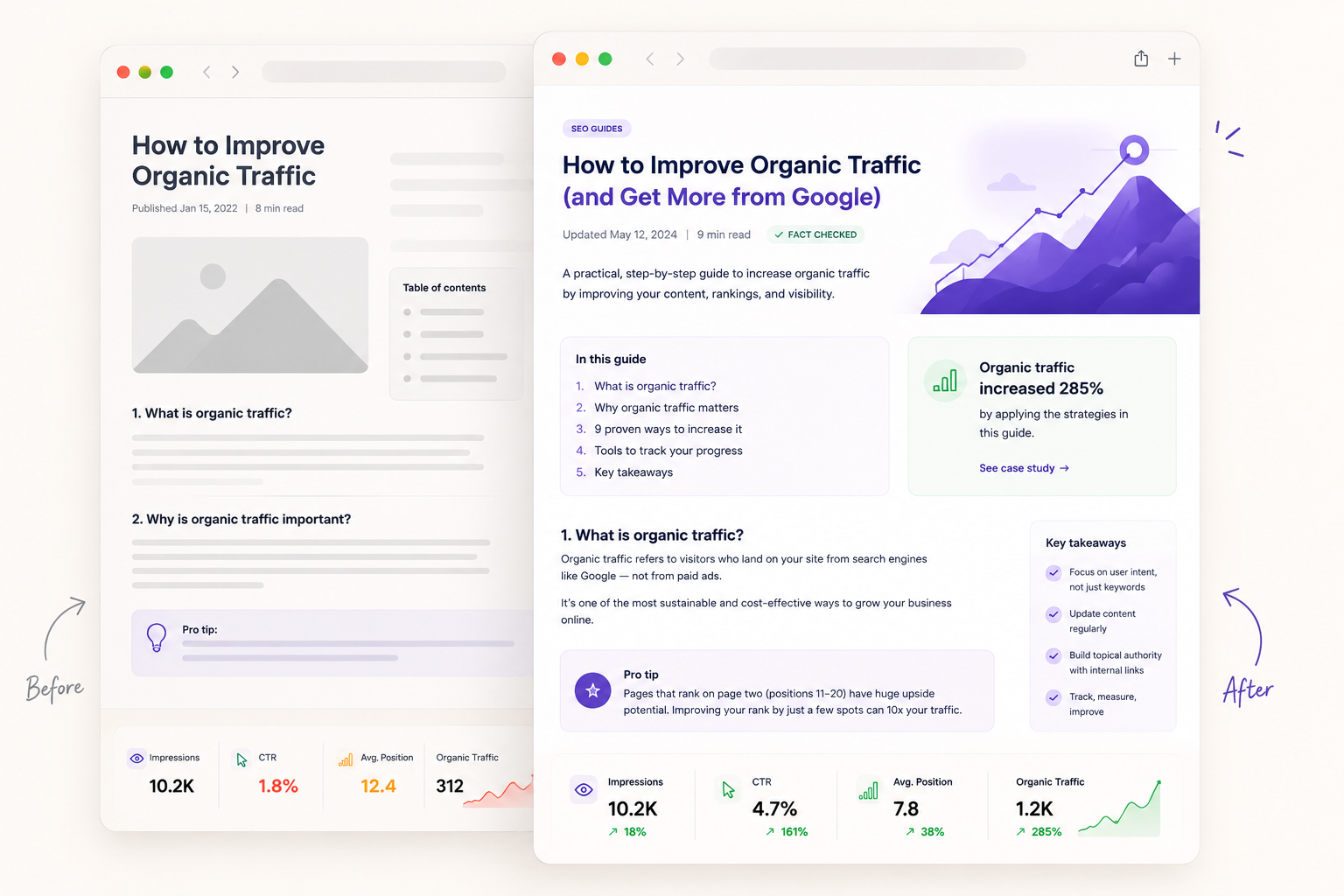
Bias toward updating over deleting when a page is close to working. A page already indexed, already accumulating impressions, has a head start that a new page takes months to rebuild. The fixable problems are almost always the same handful: a weak title, an answer buried too deep, a missing or vague CTA, and no internal links pointing at the page from stronger content. Fix those four things before you write anything new.
The pages worth updating should be slotted into your content calendar as explicit tasks, alongside new pieces — not treated as a separate project you will get to eventually. Eventually does not happen.
What should you prioritise in the update pass?
Not all updates are equal. Three types of pages return the highest effort-to-result ratio and should go first.
Pages stranded just below page one. A page ranking in positions eleven to twenty is a click-magnet waiting to happen. First-page results capture 91.5% of all Google traffic; page two gets 4.8%. Moving one page from position twelve to position eight can produce more traffic than publishing three new ones. These are your highest-priority updates. Add depth, freshen the data, strengthen internal links pointing in.
Pages with impressions but single-digit CTR. The keyword is relevant and Google already knows it — the problem is the promise the title makes. Rewrite the title to answer the searcher's actual question, front-load the primary keyword, and rewrite the first paragraph to match. A 2% to 5% CTR improvement on a page with ten thousand monthly impressions is material.
Pages that were right for a topic but need a credibility refresh. Statistics from 2021 still being cited in 2026 are a trust and ranking problem. Update every data point with the current year's source, add anything that has changed in the category, and use the new publish date honestly.
How often should you repeat a content audit?
Once you have cleared the first wave of debt, the audit shrinks considerably — you are only reviewing what has been published or gone stale since the last pass. Set the cadence by your publishing speed and do not overthink it.
Publishing monthly: a six-month pass is ample. Publishing weekly: quarterly keeps debt from compounding. The first audit is the hardest because you are clearing years of accumulated pages. Every subsequent one is smaller, faster, and more mechanical.
The smarter long-term move is folding lightweight maintenance into your normal workflow. Refreshing a page when its impressions start to slide — rather than waiting for a formal audit cycle to catch it — means you are never clearing a backlog, just doing tidy ongoing upkeep. The signal that a page needs attention comes from the same places your new content ideas do: watching what your ICP is searching for, which our social listening guide for founders covers in detail. That monitoring doubles as an early-warning system for content that has quietly drifted out of date.
And while your keyword research strategy informs what you publish next, your audit history informs what you do not need to publish again — preventing the duplication and cannibalisation that makes audits harder over time.
Where Sia fits
Sia keeps a live view of how every page you have published is performing — which are gaining impressions, which have plateaued, and which are quietly dragging down your topical authority. Rather than running a manual audit twice a year, you get a standing view of what to update, merge, or retire next, grounded in what your ICP is searching for right now.
Start with the inventory this week. One sheet, three signals, five possible decisions. You will almost certainly find pages worth updating that you had forgotten you wrote — and a few worth deleting that you will not miss. Your best content is more valuable after an audit than it was before one. Start there.