Building a content strategy when you're a solo founder feels like it belongs on the "do this later" list — somewhere between hiring a designer and setting up proper accounting. The problem is that content compounds, and the founders who start early win disproportionately. This guide gives you a content strategy for solo founders that is actually executable without a team, a budget, or a background in marketing.

Why most solo founder content strategies fail before they start
Most solo founders don't fail at content because they write badly. They fail because they spread themselves across five channels, post inconsistently for six weeks, see no results, and quietly stop.
The root cause is almost always the same: they started with format rather than purpose. They asked "should I be on LinkedIn or writing blog posts?" before they asked "who exactly am I trying to reach, and where do they go when they have the problem I solve?"
Content without an audience hypothesis is just publishing into a void. And for a solo founder with limited hours, a void is an unaffordable destination.
There's another failure mode worth naming: the quality trap. Founders who write exceptional one-off pieces — deeply researched, beautifully structured, genuinely useful — and then produce nothing for three months. A Semrush study found that brands publishing 16 or more posts per month earn almost 3.5× more traffic than those publishing four or fewer. Frequency beats perfection, within reason.
The fix is not to lower your standards. It's to build a system that makes consistent production possible at your current capacity — then raise quality as the system becomes habit.
Step 1: Start with your ICP, not a content calendar
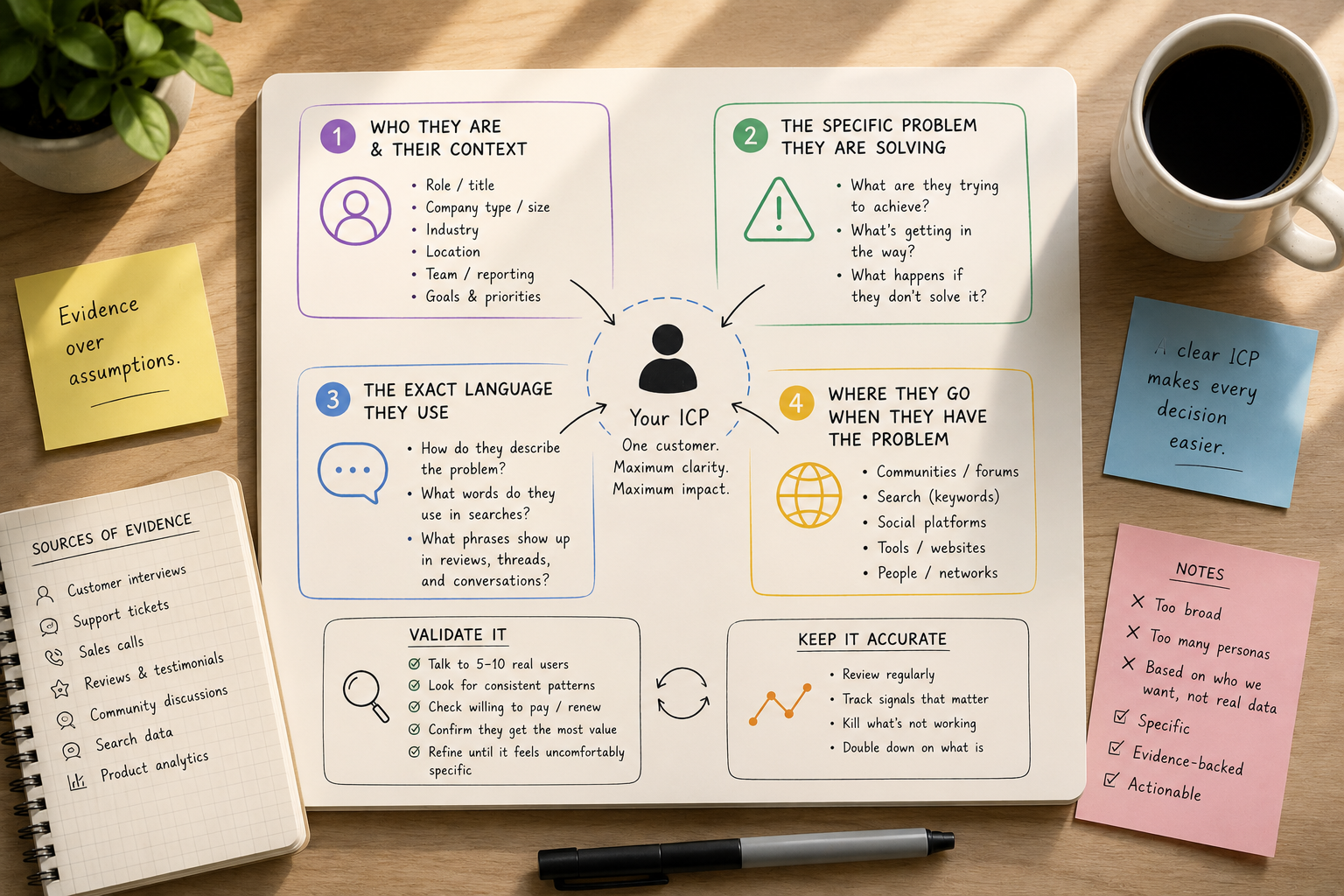
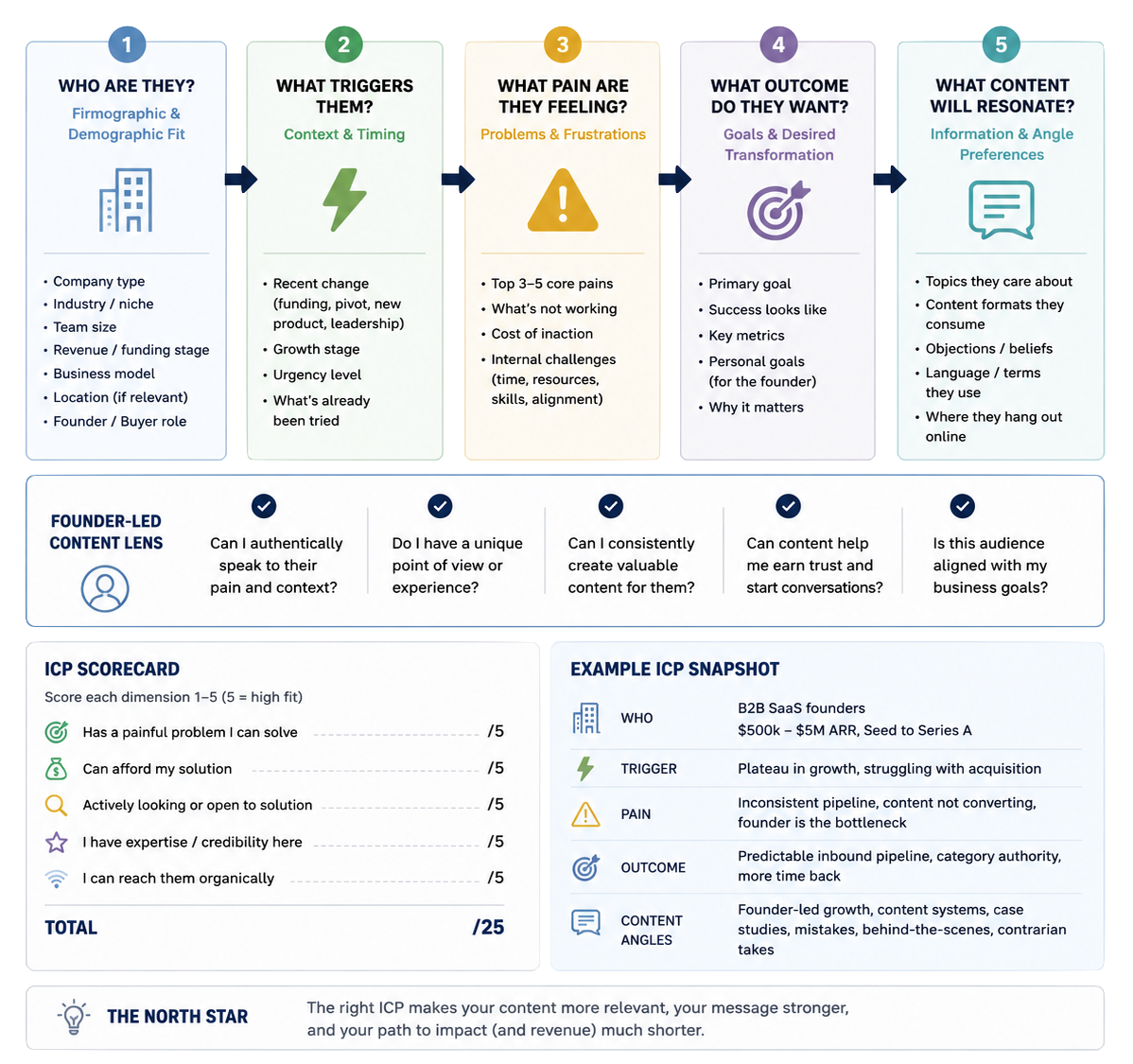
Before you plan a single piece of content, you need a specific, evidenced picture of who you're writing for. Not a market segment — a person.
The useful ICP for content purposes answers four questions:
- What is their role and context? Not "SMB owner" — "a technical founder who has just launched their first SaaS product and is managing growth themselves for the first time."
- What is the specific problem they're searching for help with? Not "growth" — "how to get their first 100 customers without a marketing budget."
- What language do they use to describe the problem? This is the one founders most often skip. The phrases your ICP types into Google are not the phrases you use to describe your solution. They describe the pain in their own language, which is often blunter, more specific, and more emotional than your positioning copy.
- Where do they go when they have the problem? Reddit threads, LinkedIn, Indie Hackers, specific newsletters, Slack communities. The channel that matters is the one where your ICP already congregates — not the one that's easiest for you to use.
Once you can answer those four questions with specifics — not hypotheses — you have the foundation for every content decision that follows. Your ICP definition should be a living document. Update it every time a real conversation, a Reddit thread, or a sales call gives you clearer signal about who they actually are. If you haven't pinned this down yet, start with our ICP definition guide.
How do you find keywords worth targeting without a specialist?
The honest answer is that you don't need a specialist — you need a small, systematic process that takes two hours and produces a keyword list that will outlast any tool subscription.
Start with your ICP's language, not a keyword tool. Go to the subreddits, LinkedIn posts, and community threads where your ICP is active. Look for the exact phrasing they use when they describe the problem you solve. Write it down verbatim. These are your seed keywords.
Validate volume and competition. Take your seed list into a keyword research tool — Ahrefs, Semrush, or even Google's free Keyword Planner — and check monthly search volume and keyword difficulty (KD). As a solo founder with a new domain, target keywords with KD under 30. You will not rank for "content marketing strategy" — but you might rank for "content strategy for early-stage SaaS founders."
Look for the gap, not the volume. The most valuable keyword for a solo founder is one where the search intent is clear, the monthly volume is sufficient (even 200–500 searches/month compounds meaningfully over time), and the existing search results are thin or generic. A page 1 full of Forbes listicles and agency blogs is an invitation — not a warning.
One finding from Ahrefs' research into over one billion web pages: 90.63% of pages receive zero organic traffic from Google. The primary reason is a failure to target queries people actually search for.
Specificity is not a limitation — it's the strategy.
Aim to build a keyword map of 20–30 target terms clustered by intent before you start producing. This is the only planning work that pays compound returns. For a step-by-step version of this process, see our keyword research walkthrough for early-stage founders.
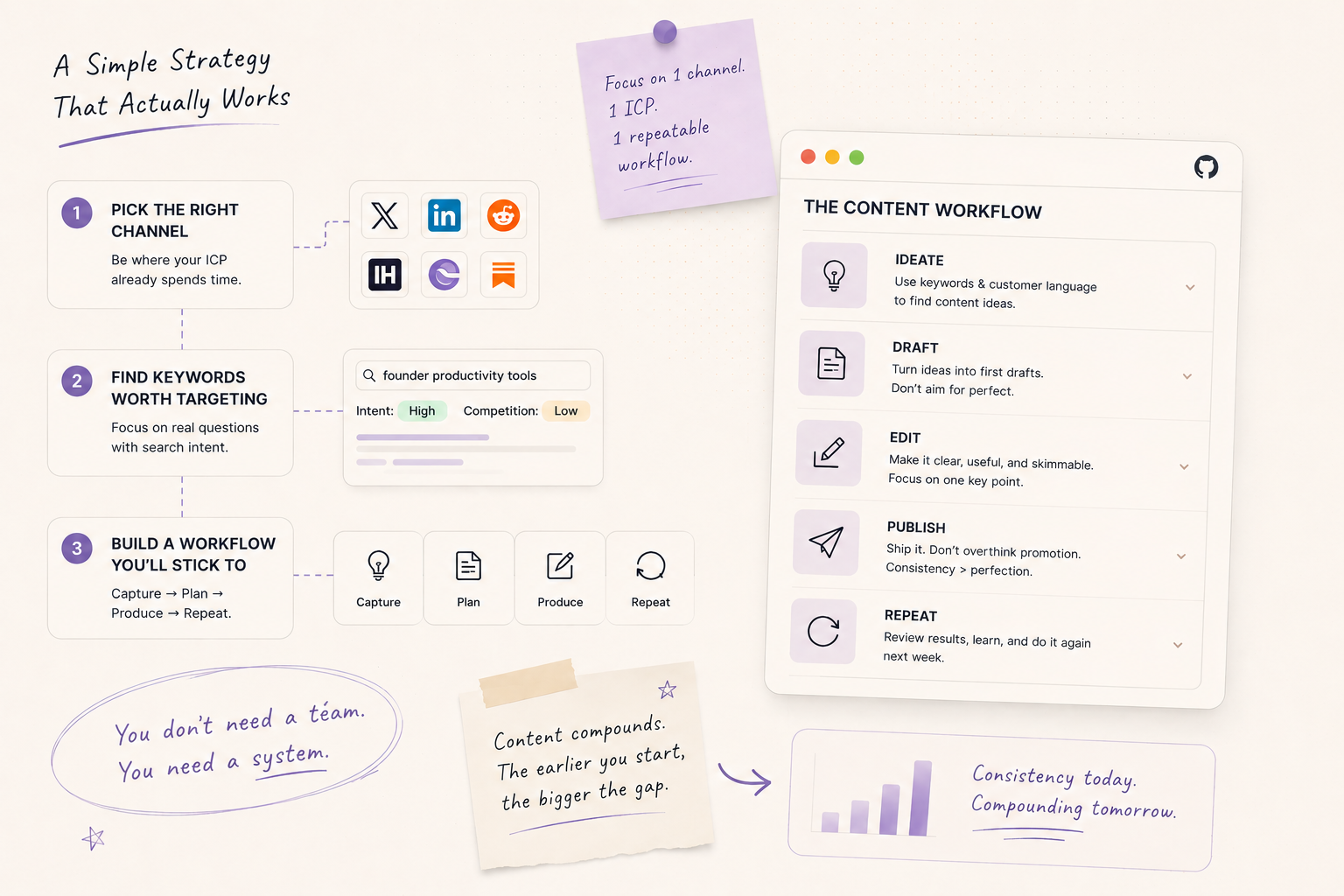
Step 2: Pick one channel and actually commit to it
The most common solo founder content mistake is channel diversification too early. LinkedIn and a blog and Twitter and a newsletter is not a strategy — it's the appearance of one.
The channel you choose determines your format, your feedback loop, and your leverage. Choose based on one criterion: where does your specific ICP already spend time and trust content?
- If your ICP is a professional buyer (HR director, CFO, ops lead at a growing company), LinkedIn is where they form opinions and discover tools. Short-form posts, personal observations, and strong takes compound there via organic distribution.
- If your ICP is a technical founder or developer, Hacker News, specific subreddits, and a well-structured blog tend to carry more trust than social platforms. A single well-ranked article can drive consistent traffic for years.
- If your ICP is early-stage and bootstrapped, communities like Indie Hackers, Product Hunt, and small tight-knit Slack groups tend to be higher-signal than broad platforms.
Pick one. Commit to a 90-day test on that channel before you consider adding another. The Content Marketing Institute's annual B2B research consistently shows that the highest-performing content marketers distribute content on fewer channels than average — the advantage comes from depth of presence, not breadth.
One practical rule: the channel you choose should not require you to develop a new skill to use it. A founder who hates writing should not start a blog as their primary channel. Friction kills consistency faster than anything else.
What does a realistic solo founder content workflow look like?
The goal of a content workflow is to remove decisions from execution. Every decision you have to make mid-production is an opportunity to abandon the session. Build the workflow so that when you sit down to produce, the only question is "what word comes next."
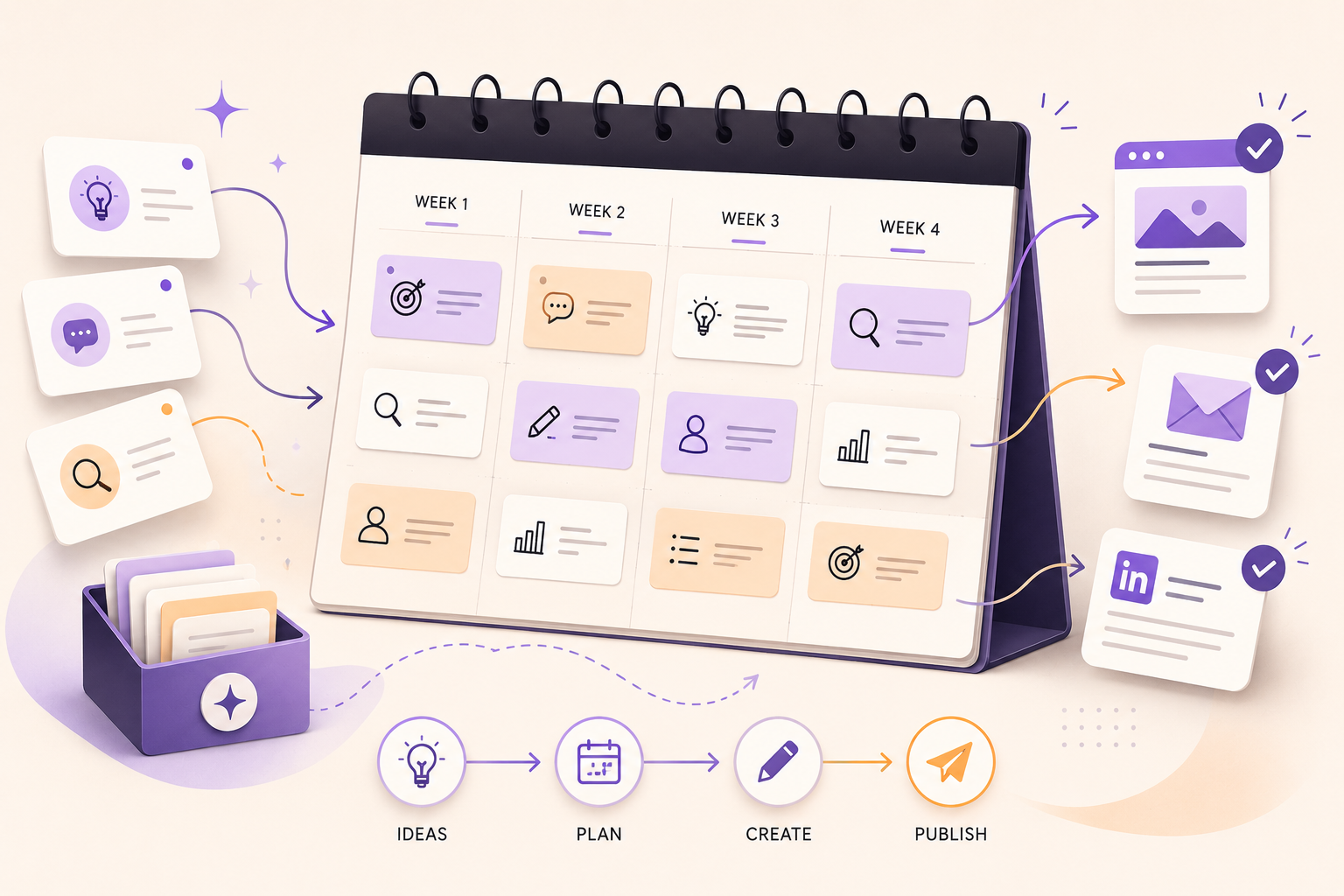
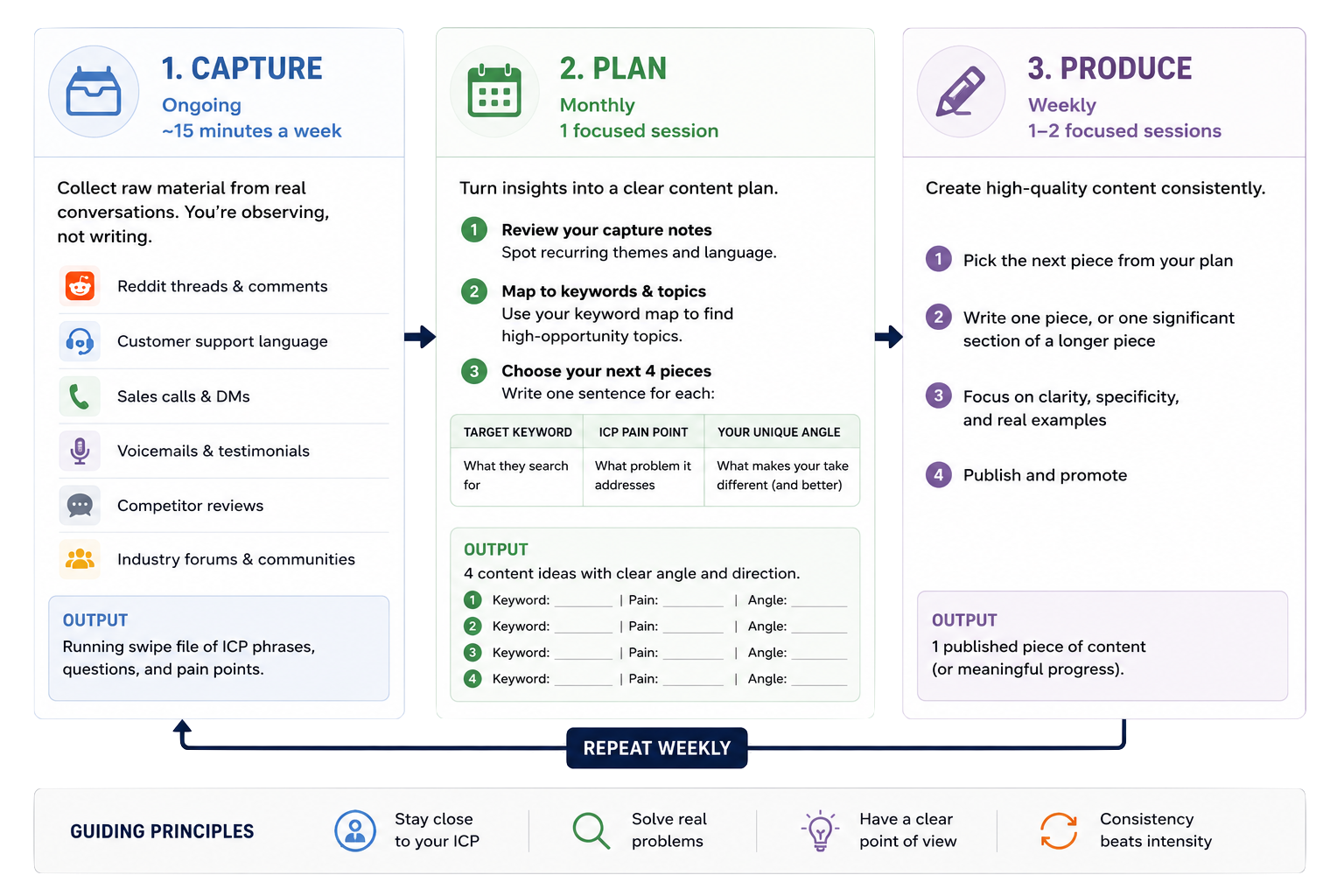
A sustainable solo founder workflow has three phases:
- Capture (ongoing, ~15 minutes a week). Keep a running note of ICP language you encounter — Reddit phrases, customer support language, things prospects say on calls. This is your raw material. You're not writing yet. You're observing.
- Plan (one session, monthly). Take your keyword map and your capture notes and select the next four pieces of content. Write one sentence for each: the target keyword, the ICP pain point it addresses, and the angle that makes your take different from what's already on page one. If you can't write that sentence, you don't have enough clarity to write the piece. A content calendar template makes this session faster.
- Produce (one or two sessions, weekly). Write one piece, or one significant section of a longer piece, per session.
The Orbit Media annual blogging survey found that bloggers who publish once a week are more likely to report strong results than those who publish less frequently — but the gap between weekly and twice-weekly is far smaller than the gap between weekly and monthly.
Done is the standard. A published post that's 80% as good as you'd like is worth five times a perfect draft sitting in Notion.
Step 3: Let your ICP do the writing for you
The most underused source of content ideas for any founder is the unfiltered voice of their target customer. Not a survey. Not a focus group. The raw, unprompted language of people describing a problem in a context where they have no reason to perform.
Reddit is the highest-signal source for most B2B and prosumer ICPs. The phrasing someone uses in a subreddit post at 11pm — when they're genuinely frustrated, genuinely stuck, genuinely looking for help — is more valuable than any keyword research tool. It tells you not just what they're searching for but how they feel about it.
Look for threads in your ICP's communities where people describe the exact problem you solve. Read the highest-voted replies. Notice the phrases that appear repeatedly. That language belongs in your headlines, your intro paragraphs, your FAQ questions. When your ICP reads your content and thinks "this is exactly how I'd describe it," you've won something no competitor can easily copy.
This approach also generates a direct pipeline of FAQ content. The questions people ask in communities are the questions they'll type into Google — often word for word. A FAQ section built from real Reddit phrasing will rank for long-tail queries that a keyword tool would never have surfaced.
Practically: spend one hour per month doing a read-through of the three or four subreddits and LinkedIn communities your ICP frequents. Note the questions, the complaints, the "does anyone else find that..." posts. These become your next content calendar. Our social listening guide for founders covers how to run this without it eating your week.
Step 4: Track the right signals and cut what isn't working
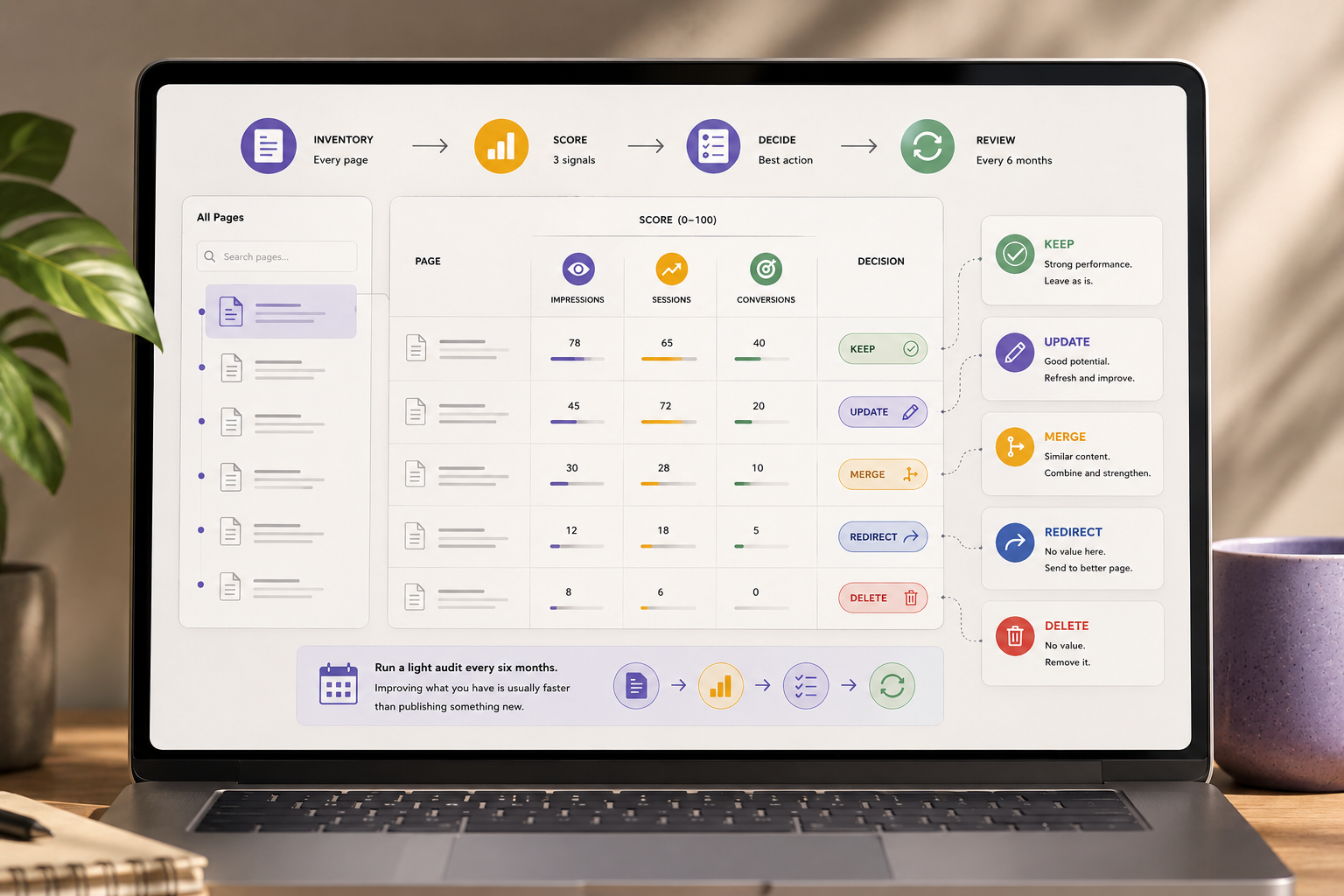
For a solo founder, measurement has to be ruthlessly minimal. You don't have time to live in analytics. You need three signals and a decision rule.
- Organic search impressions (Google Search Console, free). Shows whether your content is getting crawled and appearing in search results. This is the leading indicator — it moves before traffic does. A piece that has 2,000 impressions and a 2% click-through rate has a different problem than a piece with 200 impressions.
- Organic sessions per page (Google Analytics 4, free). The lagging indicator. Which pages are actually driving traffic? After 60–90 days, any piece that has indexed but receives fewer than 20 organic sessions a month is either targeting a keyword nobody searches for, or ranking outside the top 10. Either way: update it or redirect the effort.
- Conversion signal (newsletter signups, trial starts, or any next-step action from the post). This is the metric most founder-led content ignores. Traffic without a defined next step is brand awareness, not a growth lever. Every post should have one CTA connected to a measurable action.
The decision rule: after 90 days, review your lowest-performing pieces. For each: is the problem the keyword choice, the angle, the quality, or the missing CTA? Fix the fixable ones (update the intro, add internal links, add a CTA). Kill the rest. Content debt — old posts that dilute your topical authority — is a real drag on domain performance. Our content audit guide walks through how to decide what to update, redirect, or remove.
Where Sia fits
Sia builds and maintains a live content strategy for your specific product and ICP — mapping keywords, spotting content gaps, and drafting articles grounded in what your target customer is actually searching for right now. You keep the point of view; Sia carries the systematic, repeatable load so consistency stops depending on a good week.
Start this week. One channel, one ICP, one keyword map, and a workflow you can run on your worst day. Do that for ninety days and you'll have what most founders never build: content that compounds because you showed up consistently, first.