
Most keyword research guides open a tool, type in a broad term, sort by volume, and tell you to chase the biggest numbers. This is exactly how a founder on a new domain ends up spending months writing posts that never rank — competing against sites with years of authority and thousands of backlinks for terms that were always out of reach.
This walkthrough does it differently. It starts where your customers actually are, builds a seed list from their own words, and turns that into a publishing queue you can work through one piece at a time. No specialist, no large budget, and no targeting keywords you cannot win yet. If you have not yet defined who you are building this for, work through our ICP definition guide first — every step here depends on having a specific person in mind, not a market segment.
Why does keyword research usually start in the wrong place?
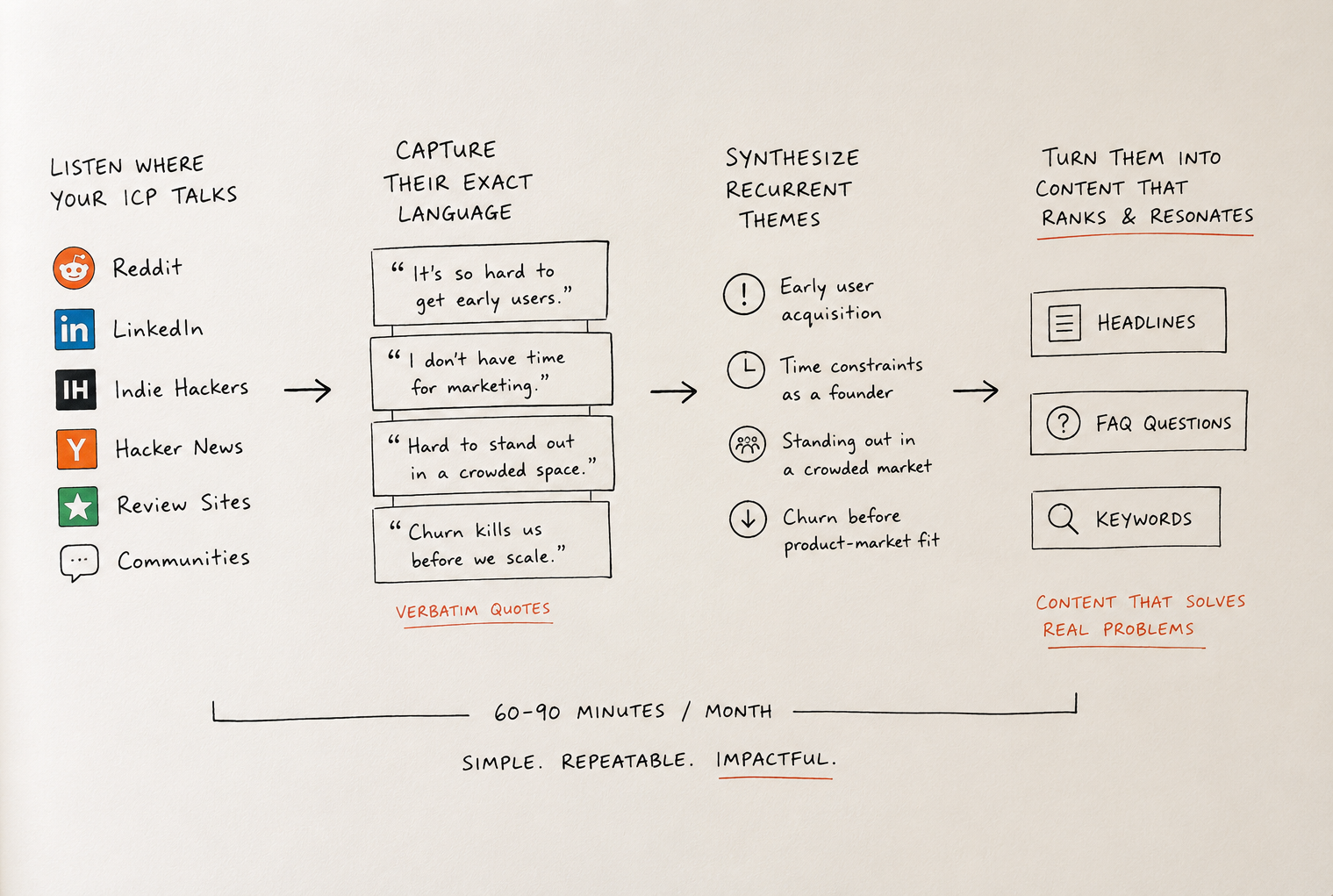
A keyword tool can only tell you about phrases someone has already typed. It cannot tell you how your specific customer describes their problem at the moment they are stuck — the language that is blunt, specific, and emotionally honest. That language lives in communities, not databases.
The cost of getting this wrong is significant. Ahrefs' study of over one billion pages found that 90.63% receive zero organic traffic from Google — and the most common reason is targeting queries people do not actually search for in the way the founder assumed. Starting from real language closes that gap before you spend a single hour writing. It also reveals long-tail opportunities that no tool's database will surface because they are too specific to show up with meaningful aggregate volume, yet they are exactly what your ICP types when they are ready to solve the problem.
The second reason tool-first research fails early-stage founders is keyword difficulty. The default view in most tools shows you the terms with the highest volume — which are also the ones dominated by sites with years of topical authority and thousands of referring domains. Chasing those is not ambition; it is misallocation. You need the terms you can win now, that build the authority to win harder terms later.
How do you build a seed list from your ICP's language?
A seed list is the raw input for everything that follows. The goal is breadth, not precision — you are collecting candidate phrases, and you will filter them later. Aim for 40 to 60 seed phrases before you start validating anything.
Pull from four sources:
Community language. Go to the places your ICP already congregates — subreddits, LinkedIn comment threads, Indie Hackers, Hacker News Ask threads, niche Slack groups — and write down their phrasing verbatim. Not your interpretation of it. The literal words. "I can't get my site to rank for anything" is a seed. So is "nobody is finding me on Google." These phrases are not polished marketing terms, and that is exactly why they work. Our social listening guide for founders covers how to mine communities systematically without it eating your week.
Your product's job-to-be-done. Phrases that describe the outcome your customer wants, not your feature names. "Rank a blog post without a big team" rather than "AI content engine." The customer searches for the job, not the solution.
Competitor and adjacent content. Skim the H2 headings of articles your ICP already reads. The subheadings reveal subtopics and the exact phrasing a category uses. You are looking for the specific questions and framings they answer.
Google's own suggestions. Type a seed into Google and read the autocomplete dropdown, the "People also ask" box, and the "Related searches" section at the bottom of the results page. Every item in those sections is a real query with proven demand. Collect every relevant one.
The keyword your competitor ignores because the volume looks too small is often the one your new domain can win and compound from.
Keep everything in a single spreadsheet, one phrase per row. You are not writing or planning yet — you are stocking the inventory. The discipline of writing each phrase down, including the ones that feel too specific, is what produces the long-tail terms a new domain can realistically rank for.
How do you validate volume and keyword difficulty?
Now you take the seed list into a tool to attach two numbers to each phrase: monthly search volume and keyword difficulty (KD). You can do this with Ahrefs, Semrush, or the free Google Keyword Planner — the method is identical regardless of which you use.
For each seed, record two numbers:
Monthly search volume. How many times the phrase is searched each month. Do not dismiss small numbers. A term with 200 monthly searches and clear buying intent compounds meaningfully over a year and converts better than a vague high-volume term with broad, unfocused intent. Note that 91.8% of all search queries are long-tail keywords with lower individual volume but specific, intent-driven phrasing — these are exactly where new domains compete.
Keyword difficulty. A 0–100 estimate of how competitive it is to rank on page one, based largely on the authority of sites currently ranking. This is the number that decides whether a keyword is realistic for you right now, or whether you need to come back to it in twelve months.
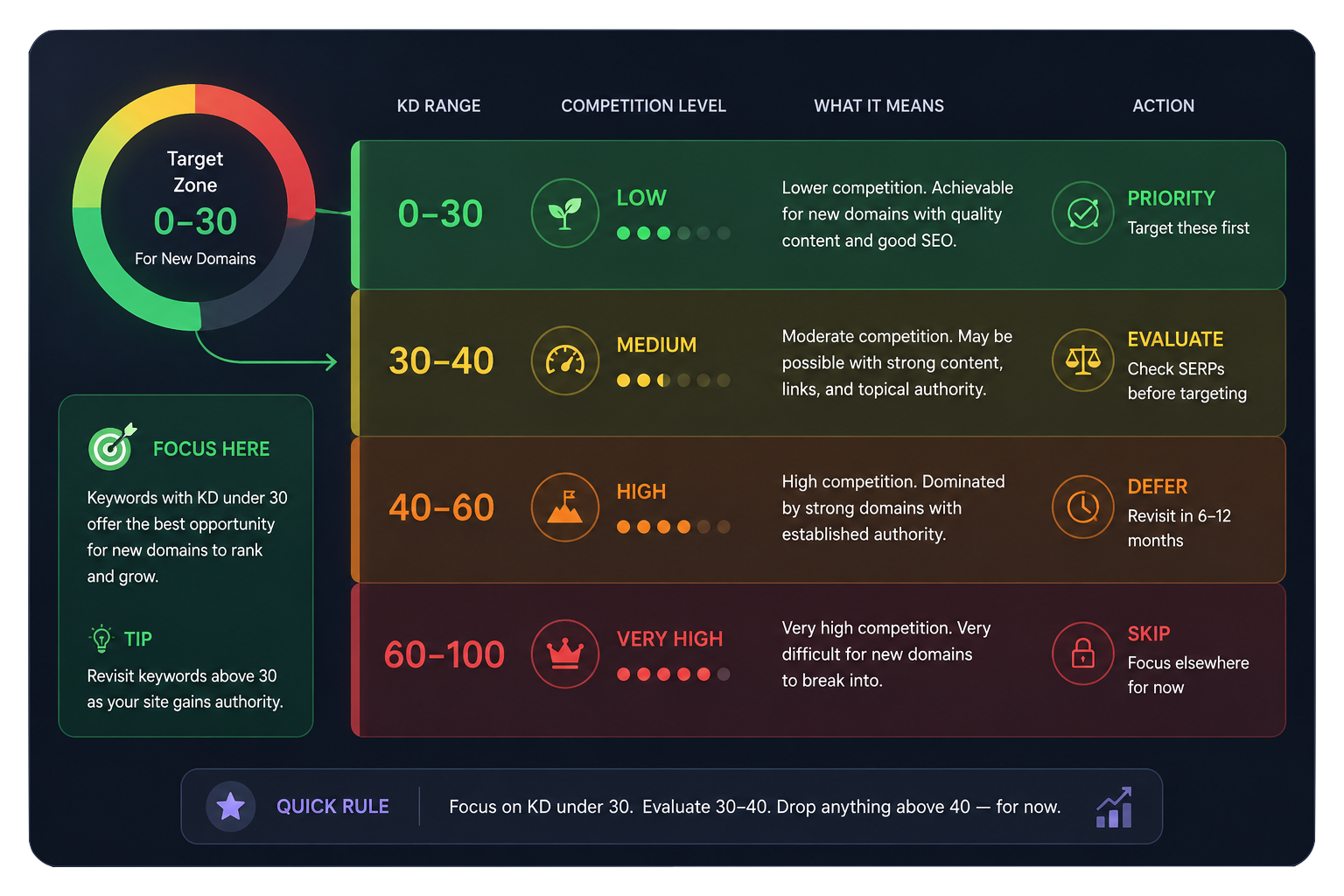
Drop any phrase scoring above 40 for now. Mark everything under 30 as a priority candidate. Between 30 and 40, apply manual judgement — look at what is actually on page one before committing.
What keyword difficulty should a new domain target?
Under 30. On a new, low-authority domain you have not yet earned the backlinks needed to compete for harder terms, and no amount of on-page optimisation closes that gap in the short term. KD under 30 is where strong content and a handful of contextual links can realistically reach page one within a few months.
This is the strategic logic behind why "content marketing strategy" is the wrong target and "content marketing strategy for bootstrapped SaaS founders" is the right one. The second phrase has a fraction of the volume, but you can actually rank for it — and a ranked page beats an unranked one at any volume.
The threshold is not permanent. Track your domain's referring domain count over time. As that number grows through consistent publishing and occasional outreach, raise your KD ceiling: from 30 to 40 once a few pages reach page one, from 40 to 50 once those pages start earning organic links. The competitive terms are a reward for building authority, not a starting point.
One important caveat: difficulty scores are estimates, and they differ between tools. Treat KD as a filter, not gospel. The manual page-one check in the next section is what actually confirms whether a keyword is within reach.
How do you find low-competition gap keywords?
A gap keyword is one where the intent is clear, the volume is sufficient, and the existing results are weak. KD scores point you toward likely gaps, but you confirm them by hand. This is the single highest-leverage step in founder keyword research — a tool genuinely cannot do it for you.
For each keyword that survives the difficulty filter, search it in an incognito window and read page one critically. You have found a real gap when the results include any of these:
- Forum threads and Reddit posts ranking on page one — a strong signal that no one has written a proper article targeting the query.
- Generic listicles from large publishers that touch the topic but answer no specific question.
- Outdated pages — old dates, stale data, advice that no longer reflects the current state of the category.
- Intent mismatch — results that rank for the words but miss what the searcher actually wants.
When you see a page one full of those, the search results are an invitation, not a warning. You can write something more specific, more current, and more directly useful than what is already there. A new domain can outrank weak incumbents far more easily than strong ones — and the specificity of your targeting is the advantage you hold that a large publisher cannot easily replicate.
How do you cluster keywords by search intent?
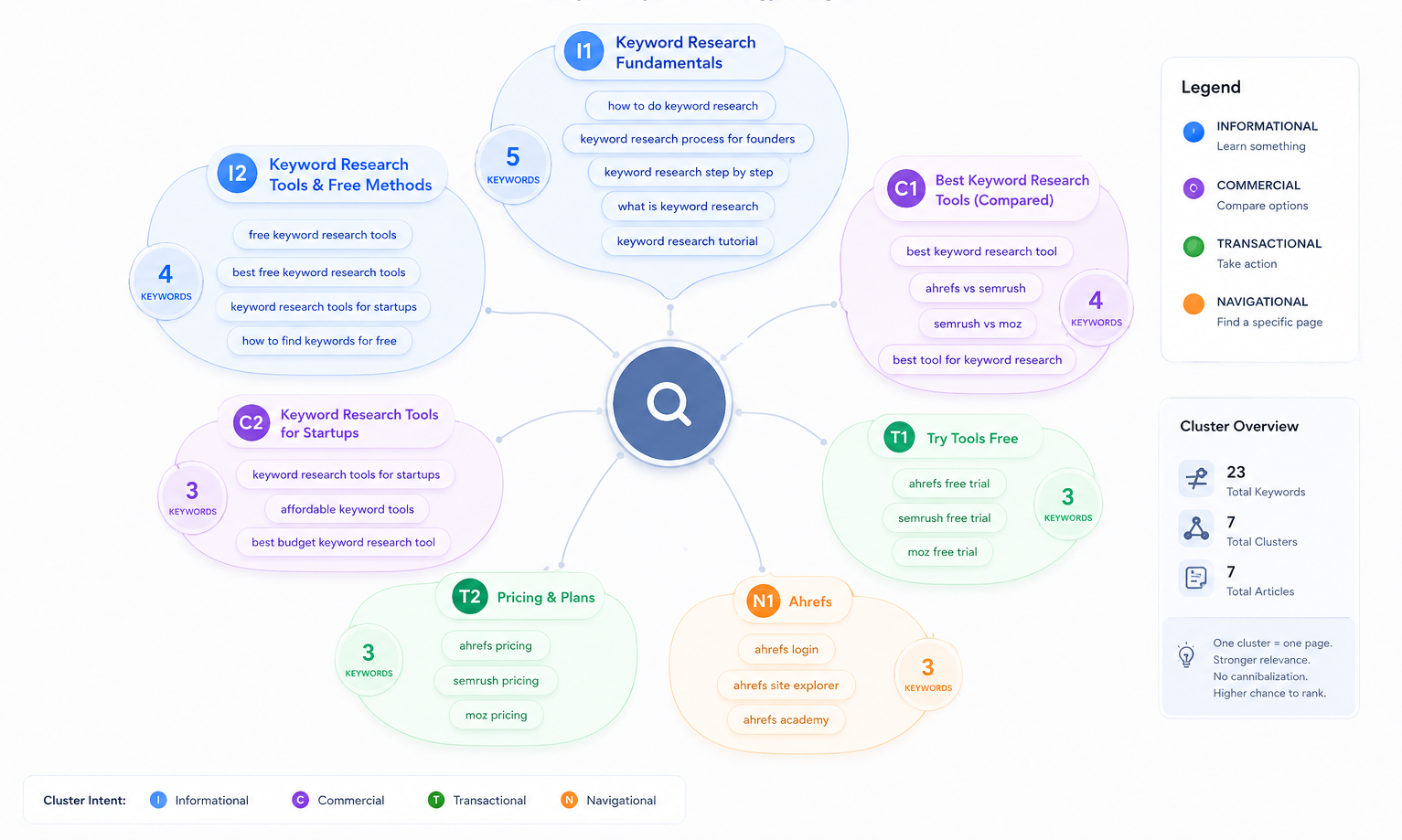
With a validated list of low-difficulty, gap-rich keywords, the next step is grouping. The grouping principle is intent — what the searcher actually wants — because keywords that share an intent usually belong on one page, not spread across several thin ones.
Four intent types:
- Informational — "how to do X," "what is Y." The searcher wants to learn. Most of your blog lives here.
- Commercial — "best X for Y," "Ahrefs vs Semrush." The searcher is comparing options before making a decision.
- Transactional — "X free trial," "buy Y." The searcher is ready to act.
- Navigational — searches for a specific brand or URL. Rarely worth targeting unless the brand is yours.
Within each intent type, cluster keywords that mean the same thing onto one target page. "How to do keyword research" and "keyword research process for founders" are one article, not two. Splitting near-identical intent across separate posts causes keyword cannibalisation — your own pages compete with each other in search results, and none of them ranks as well as a single combined piece would.
Aim for 20 to 30 keywords across 8 to 12 clusters. That is enough to establish real depth in a topic area — exactly the topical authority that search engines reward — while still being a runway a solo founder can actually work through.
How do you turn a keyword map into a publishing queue?
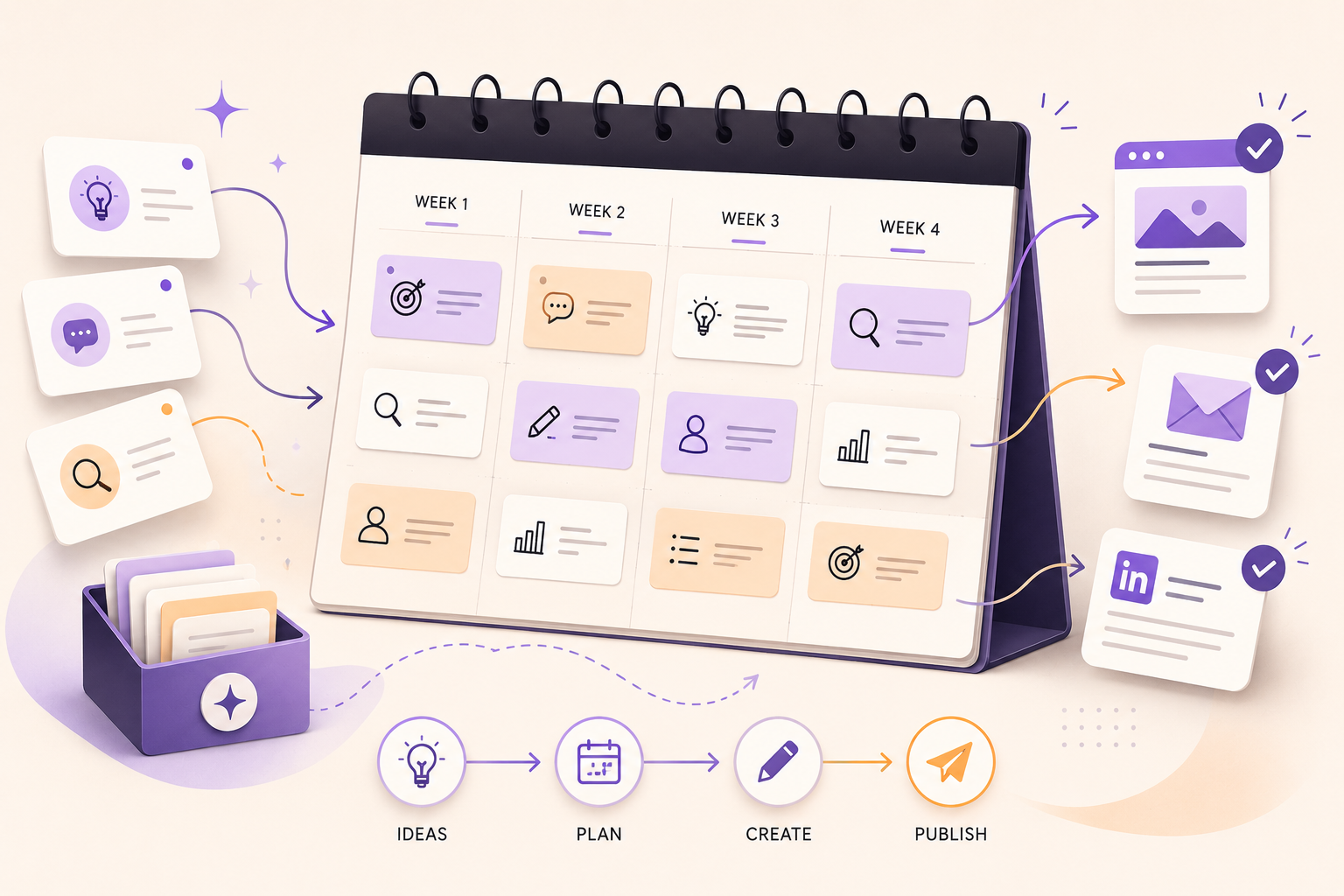
A keyword map is planning. A publishing queue is execution. The final step is ordering your clusters into a sequence you work through one piece at a time — because an ordered queue removes the "what do I write next?" decision, which is where most founder content stalls.
Order the queue by a simple priority score across three factors:
Winnability. Lowest difficulty and weakest current page one first. Early wins build the domain authority that unlocks harder terms later. One ranked page is worth more than ten posts that never reach page one.
Business relevance. How close the keyword sits to a buying decision. A commercial-intent cluster that converts beats a high-volume informational one that drives readers who never need your product.
Cluster support. Group related clusters so each new post can link to the last. Internal links within a topical cluster help all of its pages rank — a ranking advantage that compounds with each published piece.
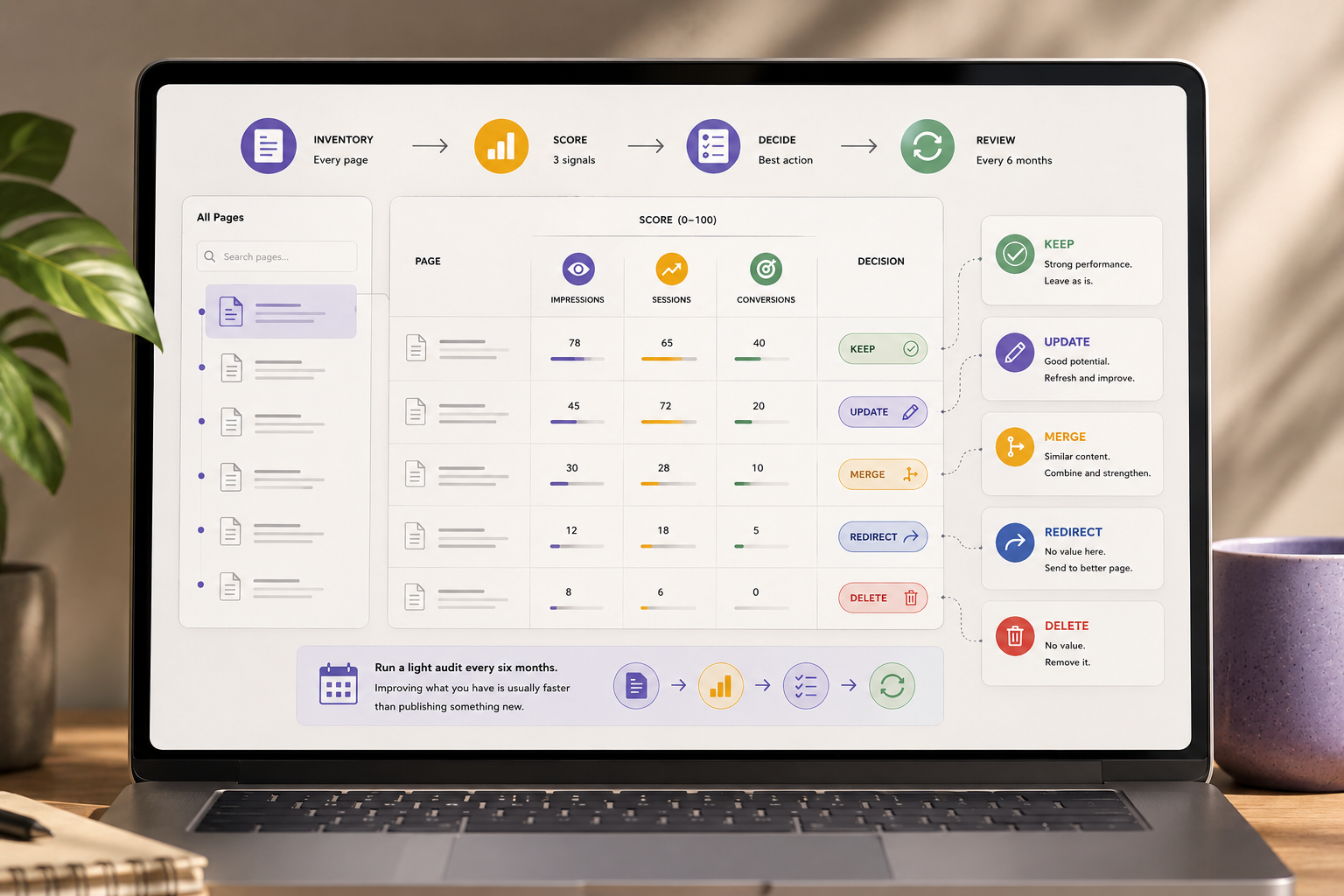
Translate each queue item into a one-line brief: target keyword, ICP pain point, and the angle that beats the current page one. If you cannot write that sentence, you do not have enough clarity to write the piece yet. A content calendar for founders turns this queue into dated commitments so it survives a busy week.
The queue is a living document. Every quarter, revisit it: drop keywords that turned out to be too competitive, add gap keywords discovered since, and fold in lessons from your content audit on what is actually ranking. Orbit Media's annual survey consistently finds that bloggers who research and plan before writing report measurably stronger results than those who publish reactively — the keyword map is what makes planning concrete rather than aspirational.
Where Sia fits
Sia runs this entire process for your specific product and ICP — mining the language your customers actually use, validating volume and difficulty, flagging the low-competition gap keywords a new domain can realistically win, and clustering them into an ordered publishing queue. You keep the judgement on what to write and what angle to take. Sia carries the systematic research so the map stays current rather than becoming a one-off spreadsheet you revisit once and then abandon.
Build the map once and you will never again stare at a blank document wondering what to write. Collect 40 to 60 seeds from your ICP's own words, validate them for volume and difficulty under 30, check the page-one gaps by hand, cluster 20 to 30 of them by intent, and order them into a queue. That map is the structural advantage most early-stage founders never build — and the reason their content starts compounding while everyone else's disappears.