Most founders abandon their content calendar not because they ran out of ideas but because the calendar became a second job. It started as a spreadsheet. Then grew a brief column, a word-count target, a six-state status workflow, and a tab for each of four channels. Within six weeks, maintaining the calendar took longer than writing the content it was meant to organise. The system collapsed under its own weight.
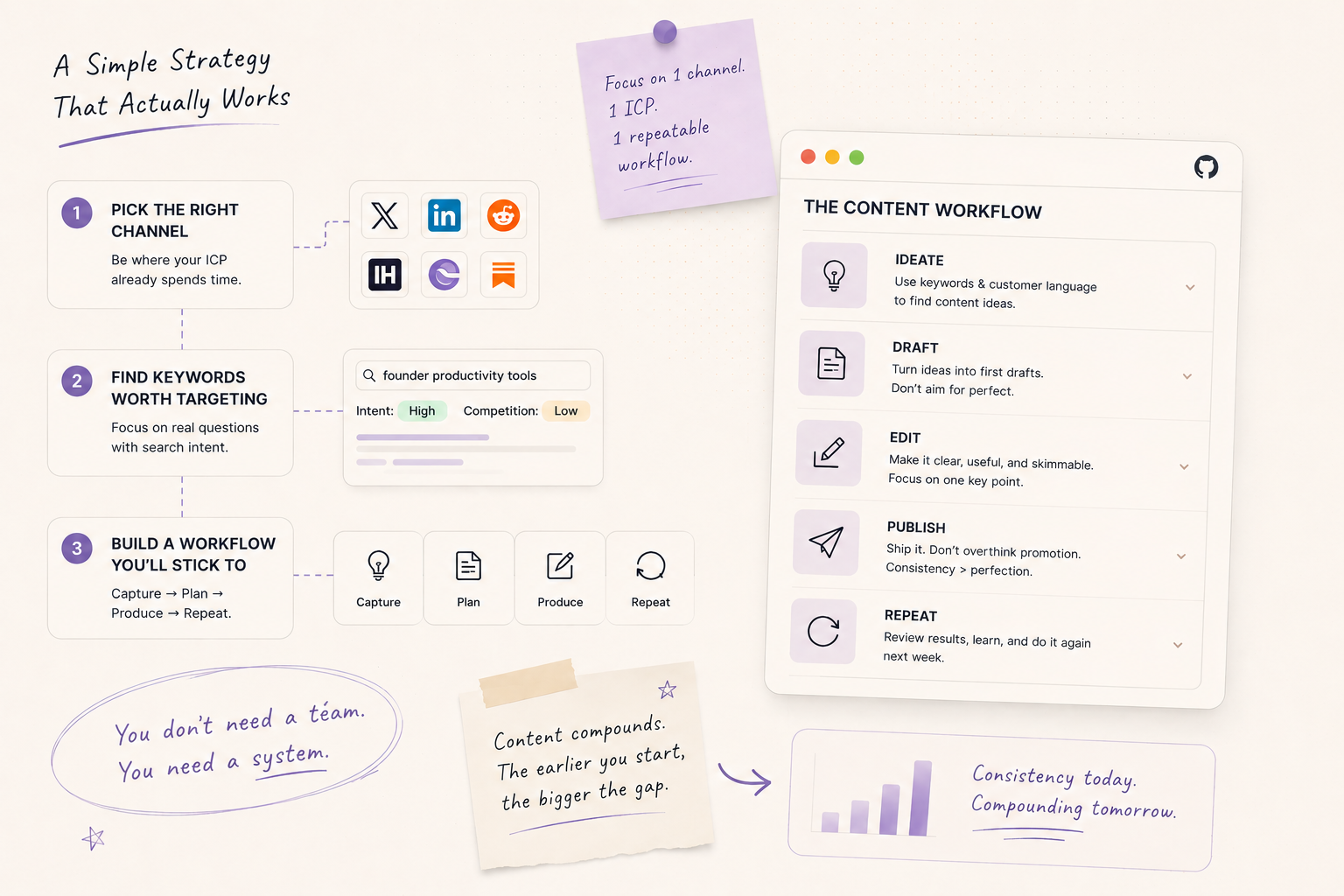
This guide gives you a content calendar for founders that survives contact with a real week — the seven fields that actually matter, a monthly planning session that takes 90 minutes, and a publishing cadence you can hold when things get busy. If you want to understand the content strategy this calendar sits inside, start with our solo founder content strategy guide, then come back here for the operational layer.
Why do most founder content calendars fail?
The over-engineering trap is the most common reason, and it is usually invisible as it happens. A calendar with two fields is fast to fill. A calendar with twelve is a project. Somewhere around field seven, upkeep begins to compete with output — and when it does, upkeep loses first, which means the calendar goes stale, which means you stop trusting it, which means you stop using it.
The second failure mode is channel sprawl. A calendar tracking a blog, LinkedIn, Twitter, a newsletter, and a YouTube channel is not five times as productive. It is five times as likely to be half-empty. The Content Marketing Institute's annual B2B research consistently shows that high-performing content teams concentrate on fewer channels than average. Depth of presence beats breadth every time. A founder who publishes genuinely useful articles once a week on one channel will outperform one who posts sporadically across five.
The fix is not more discipline. It is less calendar.
If a column does not change what you write or when you publish, it does not belong in your calendar.
What should a founder content calendar include?
Seven fields. Each one does a specific job. Drop anything that does not meet that standard.
Target keyword — the specific search query the piece is built to rank for. Not a topic. Not a category. The exact phrase someone types, in the language your ICP actually uses. If you are unsure how to source these, our keyword research walkthrough for early-stage founders covers the process from scratch.
ICP pain point — the real problem behind the keyword, in one phrase. This keeps the piece useful to a human reader rather than just optimised for a crawler.
Angle — one sentence that makes your take different from what is already on page one of Google. If you cannot write this sentence, you are not ready to write the piece. Move it back to the idea stage and pick another.
Format — article, LinkedIn post, teardown, comparison. Mostly fixed by your channel, but worth naming so you can batch similar formats in your production weeks.
Status — three states only: Idea, Drafting, Published. Resist adding more.
A four-state workflow creates a purgatory of things that are "almost done" and never
quite are.
Publish date — a commitment, not an aspiration. The date you ship, not the date you think you might ship.
CTA — the single next step the piece drives. Decide it now. A piece that ends without a CTA converts no one and measures nothing. Deciding the CTA at planning time keeps the article aimed at one outcome.
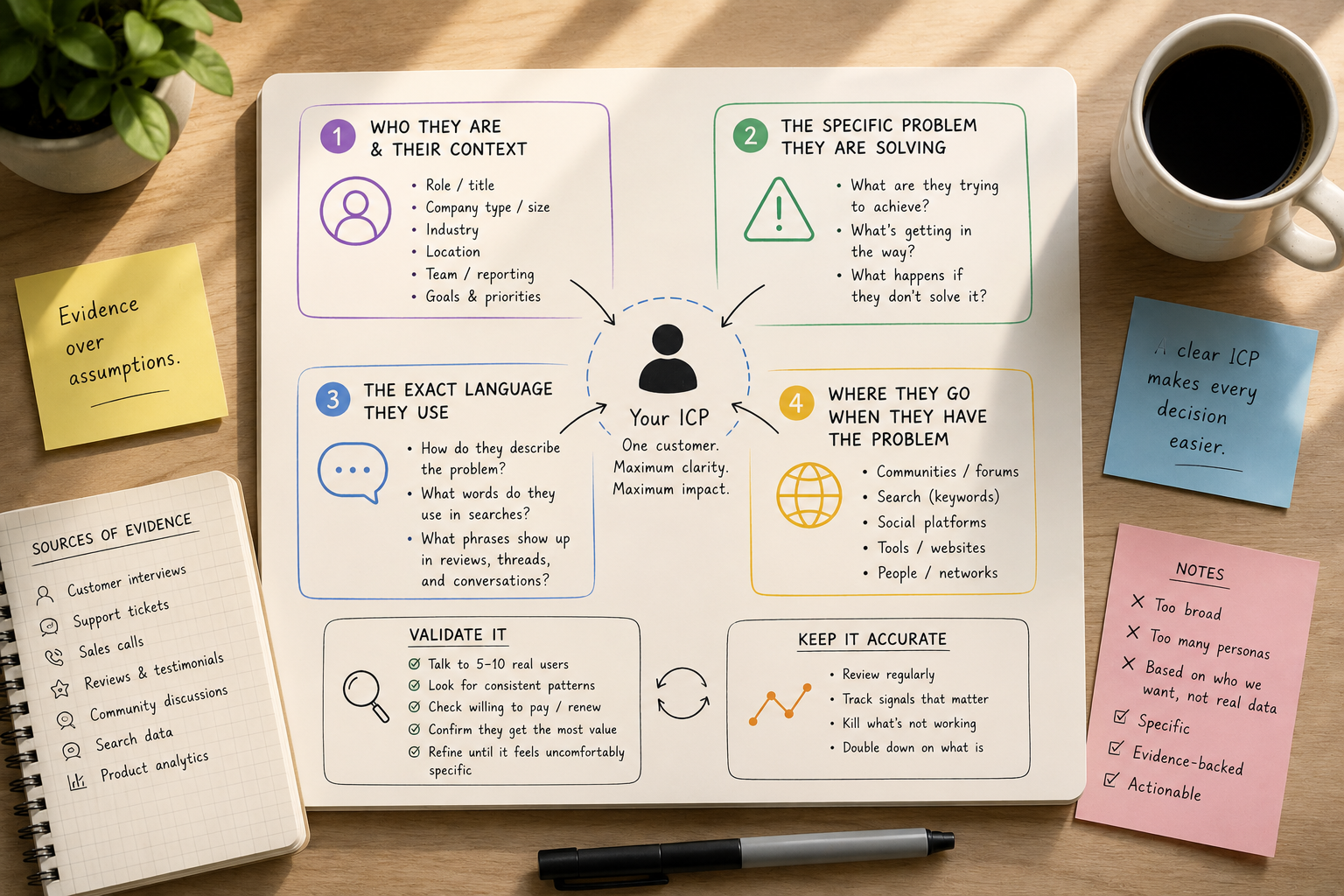
That last field matters more than founders expect. Traffic without a defined next step is brand awareness, not a growth lever. And the ICP pain point field only works if you know precisely who you are writing for — the ICP definition guide is the prerequisite work.
What does the lean template actually look like?
Here is the complete template with one month of weekly content filled in. Paste it into whatever you already open every day.
| Target keyword | ICP pain point | Angle | Format | Status | Publish date | CTA |
|---|---|---|---|---|---|---|
| saas onboarding checklist | New users churn before they activate | Built from real activation data, not generic tips | Article | Drafting | 2026-07-07 | Newsletter signup |
| first 100 customers no budget | Launched but getting no traffic | What actually worked — and the channels that did not | Article | Idea | 2026-07-14 | Trial start |
| content calendar for founders | Calendar keeps getting abandoned | The lean seven-field version | Article | Published | 2026-07-21 | Related guide |
| pricing page mistakes saas | Unsure how to price a new product | Three pricing mistakes I made and the fixes | LinkedIn post | Idea | 2026-07-28 | Profile follow |
Four rows is one month of weekly content. That is deliberate. A calendar with forty empty rows creates the illusion of planning while inviting you to design a quarter you will never deliver. Four rows you fill completely beats forty you fill halfway.
If you prefer to start from a blank structure:
| Target keyword | ICP pain point | Angle | Format | Status | Publish date | CTA |
|----------------|----------------|-------|--------|--------|--------------|-----|
|                |                |       |        | Idea   |              |     |
|                |                |       |        | Idea   |              |     |
|                |                |       |        | Idea   |              |     |
|                |                |       |        | Idea   |              |     |
Keep one view, one channel, one month visible at a time. Archive published rows to a second tab if you want a record — but never let the live view grow past what you can act on this month.
How often should you publish?
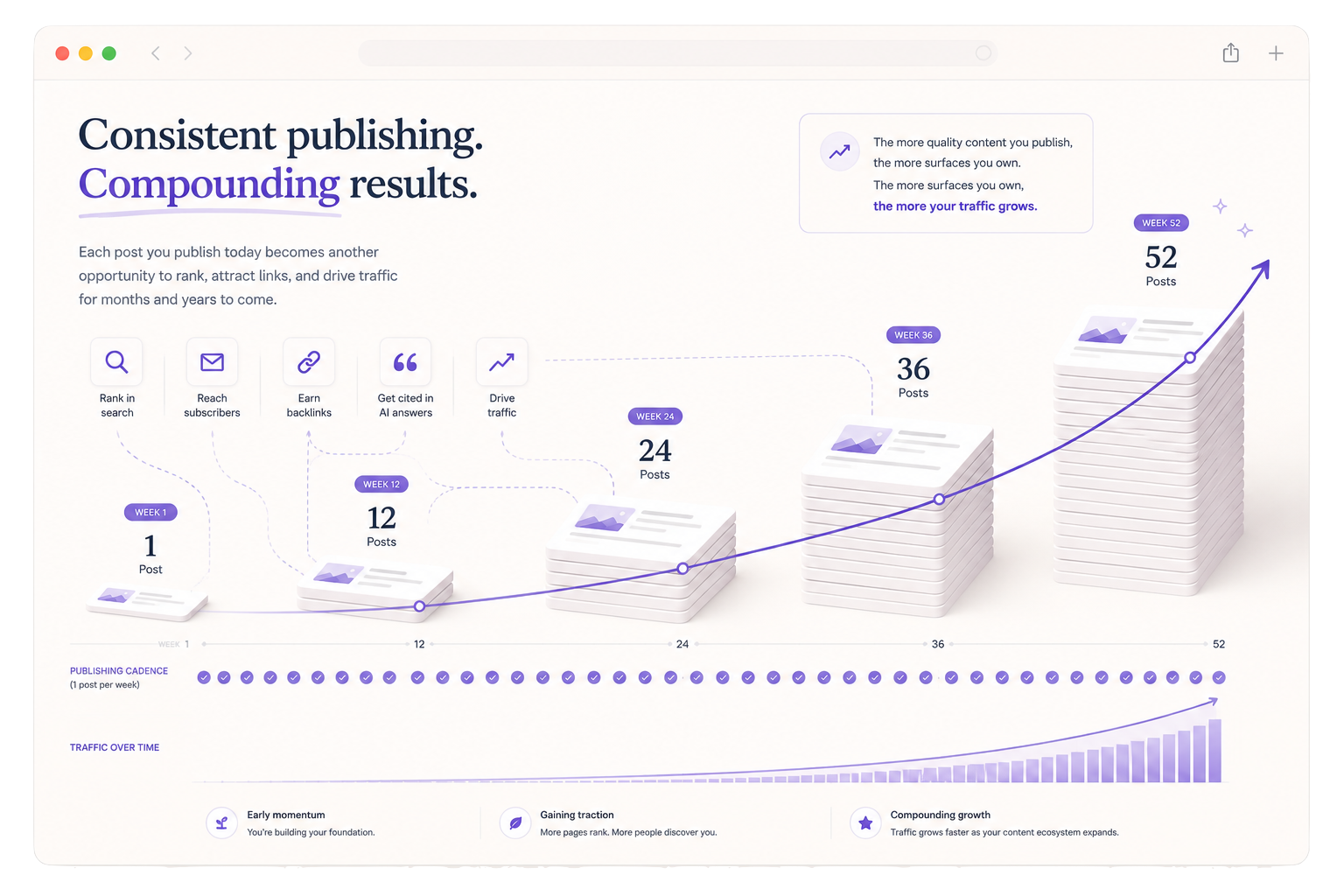
Once a week if you can sustain it; never less than twice a month. The evidence points clearly toward frequency, but the nuance matters. Orbit Media's annual blogging survey consistently finds that bloggers who publish more often report stronger results, but the meaningful gap is between weekly and monthly — not between weekly and daily. A Semrush analysis found that sites publishing sixteen or more posts a month see roughly 3.5× more traffic than those publishing four or fewer, but read that number carefully: it is not an argument for publishing sixteen times. It is an argument that consistency at a meaningful cadence — one piece a week, every week — compounds in a way that occasional publishing does not.
The practical rule: find the highest cadence you can sustain on your worst week, then hold it. The weeks when you do not want to publish are exactly where your competitive advantage is built. Every competitor who skips that week just handed you one more indexed page, one more piece of topical signal, one more entry point.
One caveat worth raising here: Google's Helpful Content guidance has made clear that padding — publishing for the sake of the schedule, without genuine value for the reader — is actively penalised. Weekly output of useful, specific, well-structured pieces beats daily output of thin ones. Choose depth over cadence when you cannot have both.
How do you run the monthly planning session?
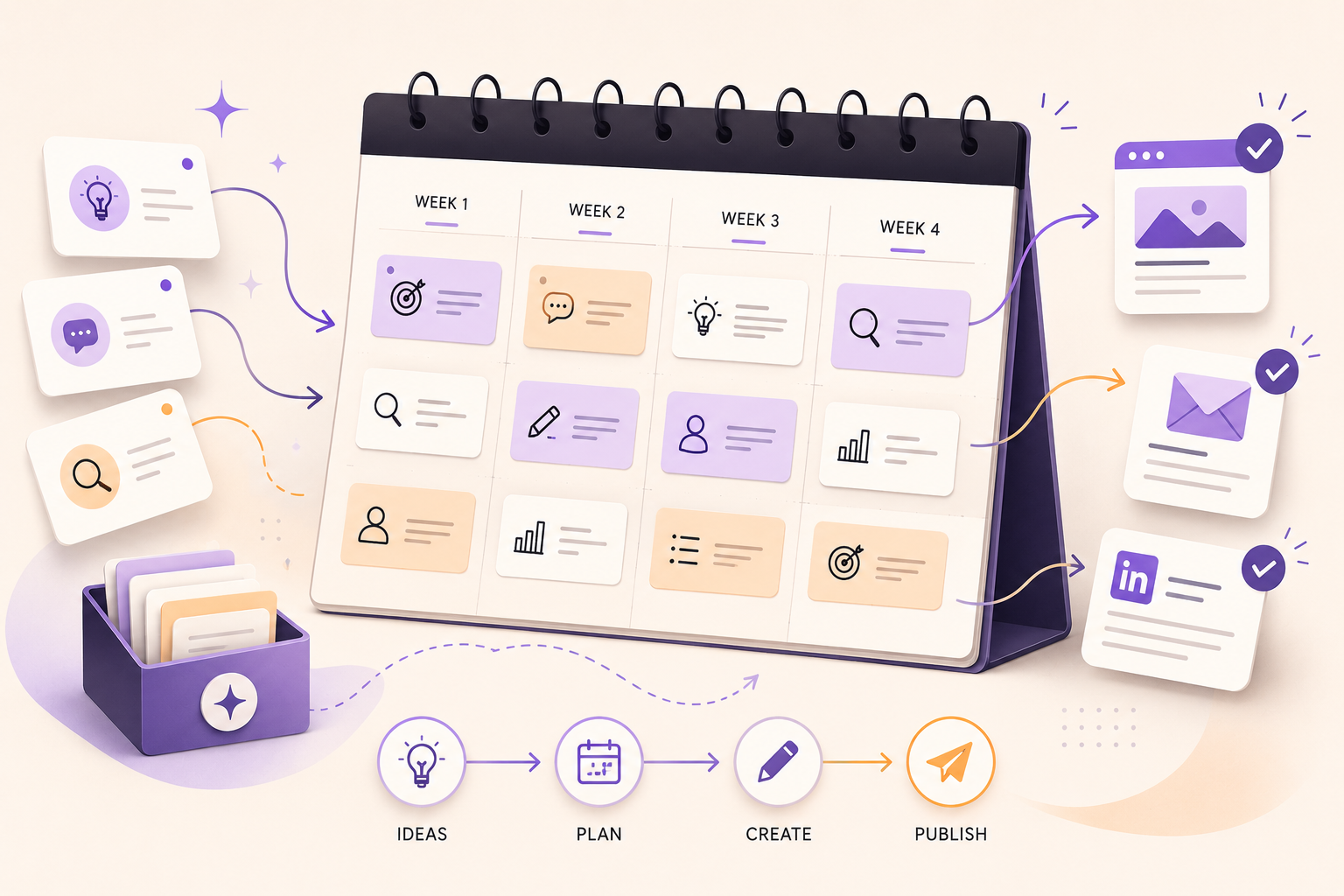
The monthly session is the engine of the whole system. It takes about 90 minutes and converts a pile of captured ideas into four committed rows. Do it the same way every month so it becomes a routine rather than a decision.
Step one: review your capture notes. Over the previous month you should have been
dropping phrases, Reddit quotes, and support questions into an Idea row as you
encountered them. The strongest content ideas are already in that list, in your
customers' own words. Our
social listening guide for founders covers
exactly how to capture that language without it eating your week.
Step two: pick four. Choose the four pieces with the sharpest target keyword and the clearest angle. Resist the urge to plan more. Four is one month. A calendar you finish beats one you abandon.
Step three: fully specify each row. For each piece, write the target keyword,
ICP pain point, angle in one sentence, format, publish date, and CTA. If you cannot
write the angle sentence, the idea is not ready — put it back in Idea and pick
another.
Step four: set the dates and stop. One publish date per week. Close the calendar. Planning further ahead feels productive but rarely survives what you learn from each piece you ship.
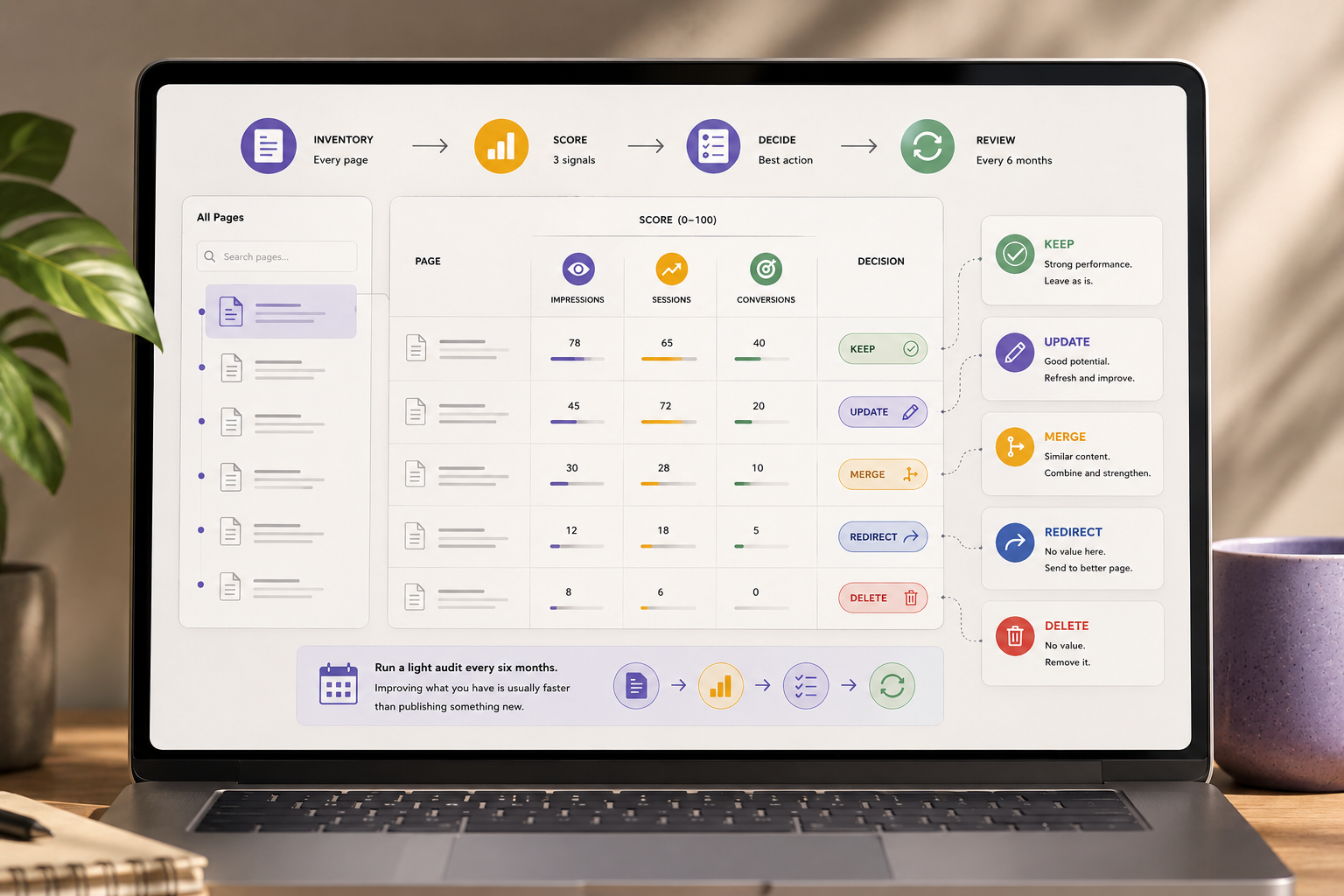
Once a quarter, spend thirty minutes reviewing what you have already published rather than what you are planning next. Old underperforming posts drag on your topical authority. Our content audit guide covers exactly what to update, redirect, or remove — and it saves you from writing on topics you have already covered without realising.
How do you sustain it on a bad week?
The batching answer is the honest one. The reason a weekly cadence feels impossible is rarely the writing itself. It is the context-switching around it — finding a keyword on Monday, deciding an angle on Wednesday, opening a blank document on Friday and rediscovering what you meant. Every switch has a cost, and across a week those costs quietly consume the hours you thought you had.
Batching removes most of that cost. Do all your keyword selection and angle-writing in the monthly planning session. Do your drafting in focused blocks where the only open question is the next word. Handle formatting, image placeholders, and links as a separate pass. Three work modes, none of which interrupt the others.
Two to three focused hours a week is enough for one well-structured piece — provided the planning is already done. The bottleneck is almost never time. It is clarity. The monthly session manufactures that clarity in advance, so your writing blocks start from a fully specified brief, not a blank slate.
Where Sia fits
Sia keeps the calendar full without the monthly session depending on a good week. It surfaces the keywords your ICP is searching for right now, drafts the angle, and produces the piece — leaving you to set the point of view and hit publish. The lean structure stays yours. Sia carries the repeatable research behind it.
Build the calendar this week. Four rows, seven fields, one channel, one month. Fill it in a single 90-minute session, then produce against it on a cadence you can hold on your worst week. The founders whose content compounds are not the ones with the most elaborate systems — they are the ones who kept a simple one current.